
Finding a good water filter is surprisingly tricky when you rent. You may not be allowed to drill through the counter, alter the plumbing, or install a permanent faucet. Then there is the space problem: in a studio apartment, galley kitchen, dorm-style setup, or tiny home, every inch beside the sink has to earn its keep.
The good news is that today’s countertop systems offer multiple solutions. A refillable electric dispenser can provide filtered water at the push of a button. A compact reverse osmosis appliance can reduce a broader range of dissolved contaminants without connecting to a water line. A faucet-fed model delivers fast flow without using an outlet, while a gravity dispenser can work on the counter or inside the refrigerator. The right choice depends less on flashy stage counts and more on your water, your lease, and your daily routine.
For this guide, I focused on removable designs sold on Amazon.com, practical footprints, replacement-filter availability, published performance information, and features that make sense in a small U.S. kitchen. I also reviewed certification language carefully. No household filter removes every possible contaminant, and a long list of claims is only useful when the exact model has documentation to support it. Before buying, check your local Consumer Confidence Report or test private well water, then match the filter to the substance you actually want to reduce. Prices and availability change, so confirm the model number and current specifications on the listing before ordering.
Quick Comparison
| Product | Best for | Setup | Filtration style | Electricity |
|---|---|---|---|---|
| Brita Hub | Best overall for daily convenience | Refillable reservoir | Non-RO replaceable filter | Yes |
| AquaTru Carafe | Best independently certified countertop RO | Refillable tank | Four-stage reverse osmosis | Yes |
| Bluevua ROPOT-UV | Best feature-rich RO option | Refillable tank | Six-stage RO, UV, and remineralization | Yes |
| Waterdrop CTF-01 | Best budget faucet-connected model | Faucet diverter | Five-stage non-RO filtration | No |
| LifeStraw Home 18-Cup | Best electricity-free dispenser | Gravity-fed reservoir | Membrane, carbon, and ion exchange | No |
What Certifications Should You Look for in a Countertop Water Filter?
Certification numbers aren’t scores, and a higher number doesn’t automatically mean better filtration. Each standard covers a different type of performance. NSF/ANSI 42 generally addresses aesthetic concerns such as chlorine taste and odor. NSF/ANSI 53 covers specific contaminants with health effects, but you still need to check which reduction claims apply to the exact model. NSF/ANSI 58 is the key standard for reverse-osmosis systems. NSF/ANSI 401 concerns certain emerging or incidental compounds, including some pharmaceuticals and chemicals. NSF/ANSI 372, meanwhile, relates to the lead content of materials used in a product; by itself, it does not prove that the filter reduces lead in your water.
The wording matters, too. “Certified by” an accredited body, “tested to,” and “meets the requirements of” are not always interchangeable statements. Look for the certifying organization, exact model number, named contaminant, rated capacity, and performance data sheet. The NSF guide to residential treatment standards specifically notes that certification to one standard does not mean a device reduces every possible contaminant.
Start with your utility’s annual water-quality report and the plumbing risks in your building. If chlorine taste is the main frustration, a certified carbon-based system may be enough. If you’re concerned about fluoride, arsenic, nitrate, or dissolved solids, a properly certified RO appliance may make more sense. If you use private well water or face a boil-water advisory, do not assume an ordinary countertop model can handle microorganisms or viruses. Use a system with appropriate microbiological performance documentation and follow local public health instructions.
1. Brita Hub Countertop Water Filter System — Best Overall
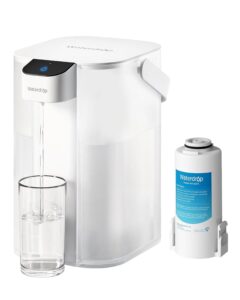
The Brita Hub is the most balanced choice here for a renter who wants better everyday tap water without turning filtration into another household project. You fill the 12-cup reservoir, plug in the machine, and choose a 12-ounce preset, 20-ounce preset, or manual pour. No faucet adapter is needed, and there’s no permanent installation to undo when you move. Its 7.5-inch width works well on narrow counters, and the reservoir base can sit behind or beside the dispenser—an unusually useful detail when an outlet, cabinet edge, or coffee maker limits your layout.
This isn’t a reverse-osmosis system, so shoppers who need substantial dissolved-solids or fluoride reduction should look at a documented RO model instead. For typical treated municipal water, however, the Hub combines convenient dispensing with stronger published reduction claims than a basic taste-and-odor pitcher. Brita states that model 87340 is certified to reduce more than 70 contaminants, including chlorine, lead, and microplastics, and to remove 99% of lead. Its official product page and performance information also list a 120-gallon filter rating. I would choose it for a one- or two-person household that values speed, a tidy footprint, and simple operation more than ultra-low TDS.
Product Features and Specifications
➡️ Model: Brita Hub 87340.
➡️ Reservoir capacity: 12 cups.
➡️ Dimensions: 14.4 inches high, 7.5 inches wide, and 11.4 inches long.
➡️ Weight: 7.9 pounds.
➡️ Dispensing: 12-ounce and 20-ounce presets plus manual mode.
➡️ Filter rating: Up to 120 gallons or approximately six months; sediment-heavy water may shorten usable life.
➡️ Performance: Brita says the system is certified to reduce 70-plus contaminants; check the performance data sheet for the complete model-specific list.
➡️ Water temperature: Dispenses room-temperature water only.
➡️ Installation: No plumbing connection; a standard electrical outlet is required.
Pros
✅ Narrow body works well on crowded apartment counters.
✅ Push-button presets make it easy to fill bottles and everyday glasses.
✅ Reservoir placement can be adjusted to suit the available space.
✅ Published certification covers a broad list of reduction claims.
✅ One filter is rated for up to 120 gallons.
Cons
❌ Requires counter access to an electrical outlet.
❌ Does not chill or heat the water.
❌ The reservoir must be refilled by hand.
❌ Uses a model-specific replacement cartridge.
❌ It is not reverse osmosis and is not intended to deliver near-zero TDS.
2. AquaTru Glass Carafe — Best Certified Countertop Reverse-Osmosis System
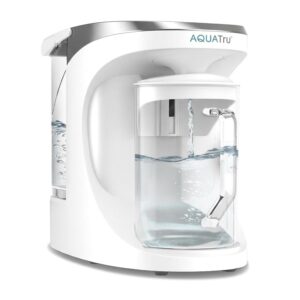
The AquaTru Glass Carafe is a compelling fit for renters who want reverse osmosis but cannot modify a sink cabinet or countertop. Its slim, 7.5-inch-wide body uses a refillable tap-water tank, so setup is essentially fill, plug in, flush as directed, and run. Purified water collects in a 64-ounce borosilicate-glass carafe that can go directly to the table or refrigerator. That feels more polished than dispensing into a fixed plastic tank, and the carafe is manageable for a small household.
Its strongest selling point is not the glass—it is the documentation. AquaTru says the Carafe has been tested and certified by IAPMO to NSF standards 42, 53, 58, and 401 for 84 contaminants. The company’s Carafe specifications and performance overview list claims that include lead, fluoride, chromium-6, nitrate, chlorine, chloramine, PFOA, and PFOS; readers should still consult the linked performance sheet for exact percentages and conditions. The tradeoffs are typical of countertop RO: it needs power, creates concentrate that must be discarded, removes many dissolved minerals along with unwanted substances, and costs more than a carbon dispenser. Still, for a renter prioritizing broad, independently certified reduction claims, this is the clearest upgrade in the group.
Product Features and Specifications
➡️ Filtration: Four stages—mechanical prefiltration, carbon, reverse osmosis, and VOC carbon filtration.
➡️ Certification: IAPMO-certified to applicable NSF/ANSI 42, 53, 58, and 401 requirements for 84 listed contaminants, according to AquaTru.
➡️ Dimensions: 13 inches high, 14 inches deep, and 7.5 inches wide.
➡️ Weight: Approximately 9 pounds.
➡️ Tap-water tank: 0.66 gallons, or 2.5 liters.
➡️ Clean-water capacity: 0.5 gallon, or 1.9 liters, in a 64-ounce borosilicate-glass carafe.
➡️ Estimated filter schedules: Pre/carbon filter about six months, VOC filter about one year, and RO membrane about two years; actual life depends on water and use.
➡️ Power: Uses a 120-volt AC wall outlet.
➡️ Installation: No feed-water line, drilling, or permanent plumbing connection.
Pros
✅ Strong independent certification and a detailed performance sheet.
✅ Narrow profile suits many small-kitchen layouts.
✅ Removable glass carafe is convenient for serving and refrigeration.
✅ Reduces dissolved contaminants that many carbon-only filters do not address.
✅ Separate filter stages have relatively long published replacement intervals.
Cons
❌ One of the more expensive choices in this guide.
❌ Requires electricity and nearby outlet space.
❌ RO processing creates reject water that must be emptied.
❌ The 64-ounce carafe may need several cycles for a busy family.
❌ Carafe-specific replacement filters are not interchangeable with other AquaTru models.
3. Bluevua RO100ROPOT-UV — Best RO System With UV and Remineralization
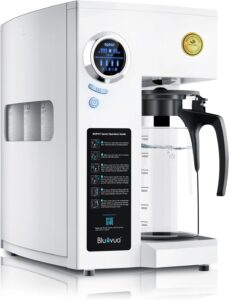
The Bluevua RO100ROPOT-UV is designed for shoppers who want the contaminant-reduction benefits of reverse osmosis but don’t love the flat taste that can follow mineral removal. After its prefilter, carbon, RO membrane, post-carbon stage, and UV treatment, a remineralization stage adds calcium and magnesium back to the finished water. Bluevua says the 60-ounce borosilicate-glass carafe is removable, refrigerator-friendly, and dishwasher-safe, and the machine requires no faucet or drain connection.
The front panel provides plenty of useful feedback. The LCD tracks filter life and processed-water volume, and it displays total dissolved solids before and after filtration. That TDS reading is convenient for monitoring membrane performance, but it doesn’t test for lead, PFAS, microorganisms, or overall safety—a low number should never replace a water-quality report or laboratory test. Bluevua’s official ROPOT-UV page describes six-stage filtration, a 0.0001-micron RO membrane, a 270–280 nm UV-LED stage, and NSF/WQA certification. Because certification can apply to particular materials or reduction claims rather than every marketing statement, check the current certificate and lab report for the exact RO100ROPOT-UV model before relying on it for a specific contaminant. It is feature-rich and renter-friendly, but it needs more counter space and a maintenance budget than a simple dispenser.
Product Features and Specifications
➡️ Model: Bluevua RO100ROPOT-UV.
➡️ Filtration: Six stages, including sediment filtration, carbon, RO, post-carbon, UV-LED treatment, and remineralization.
➡️ RO membrane rating: 0.0001 micron, according to the manufacturer.
➡️ UV stage: 270–280 nm UV-LED cycle runs with each fill.
➡️ Carafe: 60-ounce borosilicate glass, approximately seven glasses.
➡️ Monitoring: Real-time TDS display plus filter-life and processed-volume tracking.
➡️ Maintenance: Automatic rinse function; cartridge timing varies by filter and water use, so follow the LCD and manual.
➡️ Installation: Refillable tank with no permanent plumbing work.
➡️ Power: Requires an electrical outlet.
➡️ Certification note: The manufacturer describes the system as NSF and WQA certified; verify the certificate’s precise scope for the current model.
Pros
✅ Combines RO, UV treatment, and a remineralization stage.
✅ Glass carafe avoids storing finished water in a fixed plastic reservoir.
✅ Display makes filter status and TDS trends easy to monitor.
✅ No faucet adapter, drilling, or drain connection is required.
✅ Automatic rinsing reduces day-to-day guesswork.
Cons
❌ Takes up more counter volume than a pitcher-style dispenser.
❌ Needs electricity to produce water.
❌ Creates concentrate water as part of the RO process.
❌ Multiple replacement elements increase long-term ownership cost.
❌ The built-in TDS reading cannot confirm that water is free of a specific contaminant.
4. Waterdrop CTF-01 — Best Budget Faucet-Connected Countertop Filter
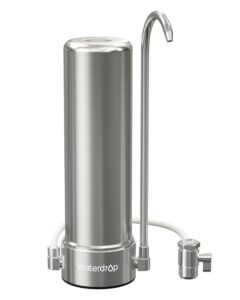
The Waterdrop CTF-01 takes a different approach: instead of filling a tank, you connect a small diverter to a compatible kitchen faucet and use water pressure to send tap water through the stainless-steel filter housing. That makes it appealing for cooking with filtered water, filling large bottles, or when you simply don’t want to wait for a gravity reservoir. It uses no electricity, produces no RO reject stream, and takes up a slender space beside the sink. When moving day arrives, you can remove the adapter and take the system with you.
The catch is compatibility. It works with many standard threaded faucets, but not every pull-out, handheld-spray, sensor, or unusually shaped tap. Check your aerator, measure the available space on the sink side, and compare the included adapters before buying. The Amazon listing identifies five-stage filtration, 304 food-grade stainless steel, a flow of up to 1.6 gallons per minute, and a rated capacity of up to 8,000 gallons or 12 months. Its published manual specifies those capacity and flow figures under test conditions. The listing also references NSF/ANSI 42, a standard focused mainly on chlorine taste and odor. Do not treat that designation as proof of lead, PFAS, fluoride, or microbiological reduction unless the current model’s certificate names that exact claim.
Product Features and Specifications
➡️ Model: Waterdrop CTF-01 with WD-CFF-01 replacement cartridge.
➡️ Filtration: Five-stage, non-RO cartridge.
➡️ Housing: 304 food-grade stainless steel.
➡️ Dimensions: Approximately 12.51 inches high, 4.92 inches long, and 3.51 inches wide.
➡️ Weight: Approximately 4.07 pounds.
➡️ Rated flow: Up to 1.6 gallons per minute at 60 psi.
➡️ Rated life: Up to 12 months or 8,000 gallons under the manufacturer’s conditions; water quality and usage can shorten service life.
➡️ Operating range: 41–100°F and 15–100 psi, according to the manual.
➡️ Setup: Connects to a compatible faucet with a diverter and hose.
➡️ Power: No electrical outlet required.
Pros
✅ Lower purchase price than countertop RO appliances.
✅ Fast flow is practical for cooking and filling bottles.
✅ No reservoir refills or waiting for an electric cycle.
✅ Stainless-steel body is compact and easy to wipe clean.
✅ Removable faucet setup can suit many rental homes.
Cons
❌ Not compatible with every pull-out, spray, sensor, or nonstandard faucet.
❌ The hose and diverter remain visible around the sink.
❌ NSF/ANSI 42 does not establish broad health-contaminant reduction by itself.
❌ Does not provide the dissolved-solids reduction of reverse osmosis.
❌ Published filter life may be shorter with sediment-heavy or poor-quality water.
5. LifeStraw Home 18-Cup Dispenser — Best No-Power Gravity Filter
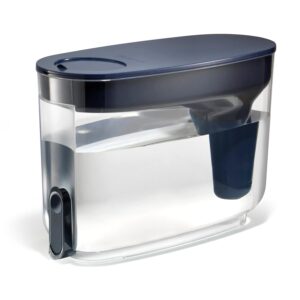
The LifeStraw Home 18-Cup Dispenser is the simplest fit for a kitchen with no spare outlet and no compatible faucet threads. Fill the top chamber, let gravity do the work, and dispense from the front spigot. At 6.44 inches wide, it takes up less side-to-side space than many large dispensers, though its 14.4-inch depth warrants a quick counter measurement. It can also live in a refrigerator if you prefer cold water and have a shelf arrangement that fits it.
Its dual-filter design is unusual in this category. A 0.2-micron membrane targets bacteria, parasites, and microplastics, while an activated-carbon and ion-exchange element handles taste, odor, selected metals, PFAS, pesticides, and other chemicals. LifeStraw publishes specific removal percentages and says the system meets the requirements of NSF 42, 53, 401, P473, and EPA/NSF P231; details are available on the company’s specifications and testing page. The manufacturer describes these as standards-aligned lab results, so readers should distinguish that language from an assumption that NSF itself certified every claim. The membrane can last up to a year, but the carbon/ion-exchange filter is rated for only 40 gallons or about two months. Flow is also slower than faucet-fed or powered machines, making this best for patient households that value plug-free operation and documented microbiological performance.
Product Features and Specifications
➡️ Capacity: 18 cups, or 144 ounces.
➡️ Dimensions: 14.4 by 6.44 by 9.56 inches.
➡️ Weight: 2.6 pounds when empty.
➡️ Materials: BPA-free, FDA food-grade-compliant plastic.
➡️ Membrane: 0.2-micron microfilter rated for 264 gallons or up to one year.
➡️ Secondary filter: Activated carbon plus ion exchange, rated for 40 gallons or up to two months.
➡️ Published performance: LifeStraw reports removal of 99.999999% of bacteria, 99.999% of parasites, and
99.999% of microplastics under its test conditions.
➡️ Minerals: Designed to retain minerals such as magnesium and potassium.
➡️ Care: Hand-wash the dispenser body and filter housing after removing the filters; do not put soap on the filter elements.
➡️ Power and installation: Gravity-fed, with no outlet, faucet connection, or plumbing alteration.
Pros
✅ Works without electricity or faucet adapters.
✅ Narrow shape can fit a counter or many refrigerators.
✅ Published testing includes bacteria, parasites, and microplastics.
✅ Retains naturally occurring minerals rather than lowering TDS like RO.
✅ Large 18-cup reservoir suits regular household use.
Cons
❌ Gravity filtration is slower than powered or faucet-fed systems.
❌ Uses two filters with different replacement schedules.
❌ The carbon and ion-exchange element is rated for only 40 gallons.
❌ The long body may not fit beneath shallow cabinets or on every refrigerator shelf.
❌ It does not provide reverse-osmosis-level reduction of dissolved solids.
Frequently Asked Questions
🙋 1. Do countertop water filters work well in rental apartments?
📝 Yes. Refillable, gravity-fed systems require no plumbing changes, and faucet-connected models are usually removable. Check your lease before altering fixtures, save the original aerator, and confirm the faucet is compatible. Electric models also need a safe outlet location away from splashes.
🙋 2. Is reverse osmosis better than a carbon-based filter?
📝 Not automatically. RO can reduce many dissolved substances that ordinary carbon media may leave behind, making it useful for concerns such as fluoride, nitrate, arsenic, or high TDS when the model carries the relevant certified claim. Carbon systems are usually faster, less expensive, retain minerals, and produce no reject water. Choose based on your water report, not the number of filtration stages.
🙋 3. Do countertop filters remove fluoride?
📝 Some reverse-osmosis appliances can reduce fluoride, but many gravity, faucet, and carbon-only filters do not. Check the exact model’s performance data sheet for a fluoride-reduction claim. Never infer fluoride performance from an NSF logo that refers to another standard or contaminant.
🙋 4. How often should you replace a countertop filter?
📝 Follow the manufacturer’s time or gallon limit—whichever comes first. Sediment, unusually high contaminant levels, heavy use, slow flow, or a change in taste can require earlier replacement. A neglected cartridge can lose performance, so include annual filter cost in your buying decision and set a calendar reminder.
🙋 5. Can I rely on a countertop system during a boil-water advisory?
📝 Follow the instructions from your local health department or utility. Many household filters are designed for already-treated tap water and aren’t certified to handle viruses or all emergency contaminants. Even if a model tests for bacteria or parasites, that doesn’t automatically cover the organism or condition behind an advisory. Boil water or use an approved alternative exactly as officials direct.
Conclusion – Best Countertop Water Filters:
For most renters using treated city water, the Brita Hub offers the easiest balance of compact sizing, push-button convenience, and documented contaminant-reduction claims. Choose the AquaTru Glass Carafe when independently certified reverse-osmosis performance is the priority, and you are comfortable with a higher price, an electrical outlet, and reject water. The Bluevua ROPOT-UV is the feature-heavy alternative for shoppers who want RO, UV treatment, a glass carafe, and minerals added back for taste.
If your budget is tighter and your faucet is compatible, the Waterdrop CTF-01 provides fast, plug-free flow without constant reservoir refills. For a no-power setup—and especially for readers interested in published bacteria and parasite performanc, the LifeStraw Home 18-Cup Dispenser is the most practical gravity-fed choice.
Before you click buy, measure the counter from the backsplash to the cabinet edge, check overhead clearance for tank removal, locate the nearest outlet, and price at least one year of replacement filters. Most importantly, match the exact certified reduction claim to your local water-quality concern. That five-minute check is more valuable than any “seven-stage” label on a product box.