

sourdough starter kit for beginners
Making your first loaf of sourdough can feel confusing. You need to feed a living starter, watch the room temperature, measure flour and water accurately, shape sticky dough, and somehow know when it’s ready for the oven. A thoughtfully assembled sourdough starter kit makes those early attempts much easier by keeping the necessary bread-making tools in one place.
The right set depends on how you want to begin. Some packages include a dehydrated sourdough culture, so you don’t have to build one from flour and water. Others focus on maintaining a homemade starter with a wide-mouth glass jar, temperature strip, breathable cover, and feeding tracker. More complete bread baking sets may add a banneton proofing basket, dough whisk, bench scraper, bread lame, and silicone Dutch oven sling.
For this guide, we compared five beginner-friendly options sold on Amazon.com. We looked at what each package includes, jar capacity, ease of cleaning, feeding and temperature trackers, proofing equipment, and whether it includes a starter culture. The Cultures for Health Artisan Bread Making Kit is our best overall recommendation because it includes a dehydrated San Francisco-style culture, digital scale, dough scraper, bread lame, and recipe cards. Beginners wanting the broadest collection of tools may prefer the 18-piece Loft & Grove kit, while the KNEADACE Pro is a more focused choice for maintaining an active culture.
Most sets don’t include flour, a Dutch oven, or every accessory required for baking. Check the included components carefully so you know what to buy separately.
Quick comparison of our top picks
| Product | Best for | Starter culture included? | Jar included? | Main tools |
|---|---|---|---|---|
| Cultures for Health Artisan Bread Making Kit | Best overall | Yes | No | Scale, lame, scraper and muslin |
| Loft & Grove 18-Piece Kit | Best complete baking set | No | Yes, 34 oz. | Banneton, whisk, lame, scraper and sling |
| KNEADACE Pro Starter Jar Kit | Best starter-maintenance jar | No | Yes, 34 oz. | Feeding band, thermometer and spatula |
| Xileanalee Two-Jar Kit | Best for two starters | No | Two 35-oz. jars | Thermometers, trackers and spatulas |
| Cultures for Health Gluten-Free Starter | Best gluten-free option | Yes | No | Dehydrated culture and instructions |
What should a beginner sourdough kit include?
At minimum, a useful beginner set should help you measure, feed, monitor, and store your starter. A wide-mouth glass jar makes stirring and cleaning easier, while a breathable cloth cover protects the mixture during room-temperature fermentation. A solid lid helps when you move the culture to the refrigerator, but you generally shouldn’t tighten it completely while the starter is actively producing gas.
A feeding band is another simple but worthwhile addition. It marks the starter’s level immediately after feeding, making it easier to see whether the mixture has doubled. Some bands also display the day and time of the last feeding. A temperature strip isn’t essential, but it can help explain why a culture is unusually slow or active.
Accurate measurement matters more than owning a large collection of accessories. A digital kitchen scale lets you measure flour and water by weight, which is more consistent than using measuring cups. For example, a feeding ratio means equal weights of starter, flour, and water, not equal volumes.
Once you’re ready to bake, a complete set may include a banneton for supporting the shaped loaf, a dough whisk for mixing, a bench scraper for handling sticky dough, and a bread lame for scoring the top. A silicone sling can make lowering dough into a hot Dutch oven safer.
The most important detail is whether the package contains an actual culture. Many products called “starter kits” provide only the jar and accessories. They help you maintain a culture, but you must create one from flour and water or buy a dehydrated starter separately.
1. Cultures for Health Artisan Bread Making Kit — Best overall
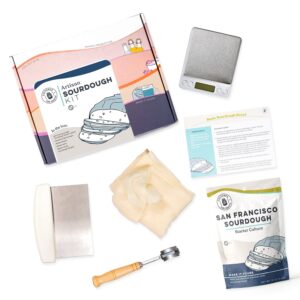
The Cultures for Health Artisan Bread Making Kit takes our best-overall position because it includes something many competing packages leave out: an actual sourdough culture. Its dehydrated San Francisco-style starter gives beginners a ready-to-use culture to activate with flour and water, rather than waiting for a new homemade mixture to develop naturally.
The kit also includes a digital baker’s scale, steel dough scraper, bread lame, butter muslin, and recipe cards. These aren’t decorative extras. The scale improves feeding accuracy, the scraper helps move sticky dough across the counter, and the lame creates a controlled opening that allows the loaf to expand during baking. You can use the butter muslin as a breathable jar cover while the culture is active.
However, this isn’t a completely self-contained bread-making box. You’ll still need a one-quart jar, flour, suitable water, mixing utensils, and a baking vessel. A banneton is not included either. This makes the set a better match for someone who already owns basic kitchen equipment but wants a dependable culture and several purpose-built tools.
The dehydrated culture contains organic white wheat flour and live cultures, so it isn’t suitable for a gluten-free diet. Activation also requires patience and regular feeding. Still, the combination of culture, weighing equipment, instructions, and baking accessories provides a sensible starting point. The complete component list is available on the manufacturer’s product page.
Product Features and Specifications
➡️ Includes one dehydrated San Francisco-style sourdough culture.
➡️ Starter culture contains organic white wheat flour and live active cultures.
➡️ Digital baker’s scale supports accurate feeding and recipe measurements.
➡️ Steel bench scraper helps divide, lift, and handle sticky dough.
➡️ Bread lame is included for scoring the loaf before baking.
➡️ Butter muslin can serve as a breathable fermentation cover.
➡️ Recipe cards provide feeding and baking guidance.
➡️ Culture should be stored in a cool, dry place before activation.
➡️ Requires all-purpose flour and suitable water for feeding.
➡️ A one-quart glass jar must be supplied separately.
Pros
✅ Includes an actual dehydrated culture.
✅ Digital scale makes weight-based feeding easier.
✅ The steel scraper is useful for both shaping and cleanup.
✅ Recipe cards give first-time bakers a clear place to begin.
✅ The culture can be maintained for future loaves with proper care.
Cons
❌ A starter jar is not included.
❌ The set doesn’t contain a banneton proofing basket.
❌ You must purchase flour, water, and baking equipment separately.
❌ The wheat-based culture isn’t suitable for gluten-free baking.
❌ Activation still takes time and requires scheduled feedings.
2. Loft & Grove 18-Piece Sourdough Starter Kit — Best complete baking set
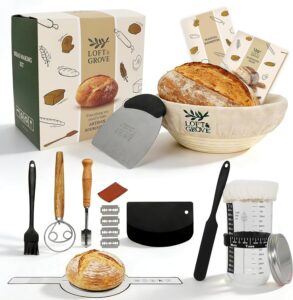
The Loft & Grove kit covers far more of the bread-making process than a basic starter jar. Its 18-piece collection begins with a 34-ounce wide-mouth glass container, breathable cover, aluminum lid, feeding tracker, and thermometer strip. Once the culture is active, the same box provides tools for mixing, shaping, proofing, scoring, and transferring the loaf to a Dutch oven.
A nine-inch round rattan banneton supports the shaped dough during its final rise. The included liner creates a smoother exterior, or you can place the dough directly in the floured basket for a traditional spiral pattern. The Danish dough whisk mixes thick, sticky dough without trapping as much mixture as a standard balloon whisk. The kit also includes a bench scraper, plastic bowl scraper, silicone spatula, bread lame, replacement blades, and silicone baking sling.
This is the most practical option in the guide for someone starting with an almost empty kitchen. The instruction booklet and recipes reduce some guesswork, but beginners should still learn to judge fermentation by the dough’s appearance and texture rather than relying only on a clock.
The main limitation is that it doesn’t include a live or dehydrated culture. You must make one from flour and water or order one separately. It also lacks a digital scale and Dutch oven, both of which would improve consistency.
Product Features and Specifications
➡️ Contains 18 bread-making and starter-maintenance pieces.
➡️ Includes a 34-ounce wide-mouth glass starter jar.
➡️ Feeding tracker helps record the most recent feeding.
➡️ Thermometer strip displays the temperature near the culture.
➡️ Nine-inch round rattan banneton includes a removable liner.
➡️ Danish dough whisk is included for mixing high-hydration dough.
➡️ Comes with metal and plastic dough scrapers.
➡️ Bread lame includes five replaceable blades and a protective cover.
➡️ Silicone sling helps transfer dough into and out of a Dutch oven.
➡️ Recipe booklet and step-by-step starter guide are included.
Pros
✅ Covers starter maintenance, mixing, proofing, and scoring.
✅ The 34-ounce jar leaves room for an active culture to rise.
✅ Banneton and liner provide two proofing-surface options.
✅ Silicone sling makes Dutch oven transfers more manageable.
✅ Instructions are helpful for someone baking a first loaf.
Cons
❌ It doesn’t include a sourdough culture.
❌ A digital kitchen scale must be purchased separately.
❌ The set doesn’t include a Dutch oven.
❌ Eighteen pieces may be unnecessary if you already own baking tools.
❌ The rattan basket must be dried carefully to prevent odors or mold.
3. KNEADACE Pro 34-Ounce Starter Jar Kit — Best jar for maintaining a starter
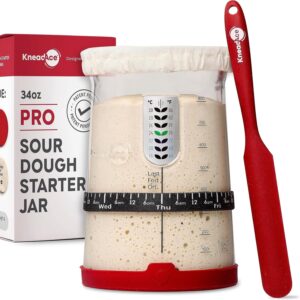
The KNEADACE Pro is designed to maintain a sourdough culture, not provide every tool needed to bake a loaf. Its 34-ounce glass jar has a rounded body and funnel-shaped opening that provide room for mixing while keeping the starter easier to pour. The larger capacity also reduces the likelihood of an active mixture overflowing after a generous feeding.
Measurement marks are printed directly on the container. These include volume, net weight, and feeding reference lines, making it easier to monitor growth without applying disposable stickers. The elastic tracking band records when you last fed the culture and shows its original level, so beginners can quickly see whether it has doubled.
The included silicone cover has two jobs. It seals the jar for refrigerator storage and can also serve as a non-slip base while the cloth cover is in use. A thermometer strip monitors the surrounding fermentation temperature, and the slim silicone spatula reaches thecontainer’s curved lower section.
This set suits someone who already owns a scale, proofing basket, scraper, and Dutch oven. It doesn’t include a starter culture or bread-baking equipment, so its “kit” label shouldn’t be mistaken for an all-in-one solution. Its strength is organization: the jar, markings, thermometer, covers, and feeding band put the most important culture-maintenance information in one place. KNEADACE’s specifications confirm the included components.
Product Features and Specifications
➡️ 34-ounce glass container provides room for starter growth.
➡️ Funnel-shaped opening supports easier mixing and pouring.
➡️ Printed volume, net-weight, and feeding-level markings.
➡️ Elastic band records the feeding day and starting level.
➡️ Thermometer strip helps monitor fermentation conditions.
➡️ Breathable cloth cover is intended for active countertop fermentation.
➡️ Silicone lid is supplied for refrigerator storage.
➡️ Silicone lid can double as a non-slip jar base.
➡️ Narrow spatula helps mix and scrape the curved interior.
➡️ Jar and accessories are intended for repeated use.
Pros
✅ Larger capacity reduces the chance of an overflow.
✅ Wide opening is easier to stir and clean.
✅ Printed measurements won’t shift like a loose sticker.
✅ Dual-purpose silicone cover saves space.
✅ The feeding tracker makes starter growth easy to see.
Cons
❌ No live or dehydrated starter is supplied.
❌ A digital scale isn’t included.
❌ It doesn’t provide a banneton, scraper, or scoring lame.
❌ The glass jar requires careful handling.
❌ Beginners still need separate baking equipment and instructions.
4. Xileanalee Two-Pack 35-Ounce Starter Jar Kit — Best for maintaining two cultures
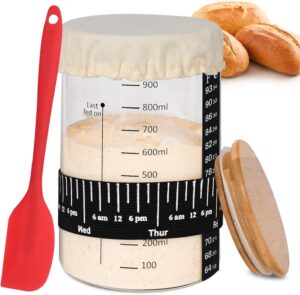
The Xileanalee kit contains two 35-ounce jars, making it useful for households that want to maintain separate cultures. You might keep a white-flour starter in one jar and a whole-wheat or rye version in the other. A second container is also convenient when you need to clean the first jar or want to keep a small backup culture in the refrigerator.
Each container has its own temperature indicator, feeding tracker, cloth cover, and storage lid. The bands record the feeding day and starting level, helping new bakers recognize when the mixture has expanded enough to use. Since both jars are wide-mouthed, it’s easier to add flour, stir thoroughly, and scrape down the sides after feeding.
The set also comes with a silicone scraper and a longer jar spatula. However, the shared utensils mean it isn’t a completely duplicated package. You may need to wash the tool between containers, especially when maintaining starters made with different flours.
This is primarily a fermentation-storage set. It doesn’t include an active culture, digital scale, proofing basket, bread lame, or dough scraper. Buyers must create or purchase their own starter and add the remaining baking equipment separately.
The two-jar format may be unnecessary for some first-time bakers, but it offers flexibility for households that bake often, experiment with several flour types, or want a backup starter for extra security.
Product Features and Specifications
➡️ Includes two 35-ounce glass fermentation jars.
➡️ Two jars allow different cultures to be maintained simultaneously.
➡️ Each container includes a temperature indicator.
➡️ Two marked feeding bands record time and starter level.
➡️ Breathable cloth covers are included for countertop fermentation.
➡️ Storage lids are supplied for both jars.
➡️ Wide-mouth design makes feeding and cleaning easier.
➡️ Silicone scraper helps remove starter from the jar walls.
➡️ Long spatula reaches deeper into the containers.
➡️ Total jar capacity is 70 ounces across both containers.
Pros
✅ Two jars allow a main culture and backup to be stored separately.
✅ Thirty-five-ounce capacity provides plenty of rising space.
✅ Each jar has its own thermometer and tracker.
✅ Wide openings simplify feeding and cleanup.
✅ Useful for comparing starters made with different flours.
Cons
❌ No actual starter culture is provided.
❌ The set doesn’t include a digital scale.
❌ Most beginners don’t need two large cultures immediately.
❌ Baking and proofing tools must be purchased separately.
❌ Glass containers take up more refrigerator space than a single jar.
5. Cultures for Health Sourdough Starter Jar Kit — Best gluten-free option
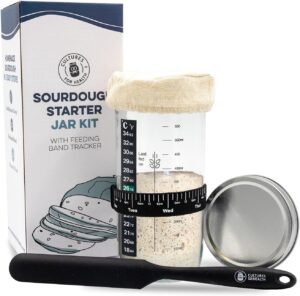
The Cultures for Health Gluten-Free Sourdough Starter is for beginners who want to bake without maintaining a wheat-based culture. It arrives dehydrated and must be activated through repeated feedings before it can raise bread dough. Once established, you can maintain the culture and use it for gluten-free bread, pizza crust, pancakes, cookies, and other fermented recipes.
This product differs from the four sets above because it includes the culture rather than a collection of equipment. You still need a clean jar, breathable cover, kitchen scale, non-chlorinated water, and suitable gluten-free flour. A feeding band and thermometer can be helpful, but they aren’t supplied.
A prepared culture gives beginners an alternative to capturing wild microorganisms from flour and the surrounding environment. However, it isn’t instant yeast. The starter needs regular care, and activation time varies with temperature, flour, water, and feeding consistency. Follow the enclosed instructions instead of assuming it will be ready on a fixed day.
Gluten-free dough also behaves differently from wheat dough because it lacks the gluten network that gives traditional loaves their stretch. A recipe written specifically for gluten-free sourdough is therefore important. People managing celiac disease or a serious allergy should review the current package label and manufacturing information before purchase rather than relying only on the words “gluten-free” in an online title.
Product Features and Specifications
➡️ Contains a dehydrated gluten-free sourdough culture.
➡️ Intended for repeated use after successful activation.
➡️ Can be maintained with compatible gluten-free flour.
➡️ Suitable for bread, pizza dough, pancakes, and other recipes.
➡️ Activation and maintenance instructions are included.
➡️ Culture requires regular feeding with flour and water.
➡️ A glass or food-safe fermentation container is required.
➡️ Kitchen scale, thermometer, and tracker aren’t included.
➡️ The starter should be stored as directed before activation.
➡️ Buyers with medical dietary restrictions should verify the current label.
Pros
✅ Provides a prepared culture for gluten-free baking.
✅ Can be maintained for future recipes after activation.
✅ Suitable for more than traditional bread.
✅ Eliminates the need to begin entirely from flour and water.
✅ Helpful for beginners following a gluten-free diet.
Cons
❌ This is a starter culture, not a complete equipment kit.
❌ A jar and all baking tools must be supplied separately.
❌ Requires compatible gluten-free flour for feeding.
❌ Activation takes time and consistent care.
❌ Gluten-free recipes may require ingredients such as binders or starch blends.
How to choose a sourdough starter kit
Decide whether you need a culture
➡️ A jar kit doesn’t automatically contain live yeast or bacteria.
➡️ Choose a package with dehydrated culture if you don’t want to create your own starter.
➡️ Confirm whether the culture is wheat-based or gluten-free.
➡️ Follow the supplied activation schedule rather than treating the culture like instant yeast.
➡️ Choose the right jar capacity
➡️ A 24-ounce container is enough to maintain a modest household starter.
➡️ A 34- or 35-ounce jar provides more protection against overflow.
➡️ Wide-mouth containers are easier to stir, scrape, and wash.
➡️ Straight or gently curved interior walls leave fewer areas where old starter can collect.
Prioritize a digital scale
➡️ Weight-based measurements are more accurate than measuring cups.
➡️ A scale makes feeding ratios easier to repeat.
➡️ Look for a model that measures in grams.
➡️ A tare function lets you subtract the weight of the bowl or jar.
Check the bread-baking accessories
➡️ A banneton supports the shaped loaf during final proofing.
➡️ A bench scraper helps handle wet dough and clean the work surface.
➡️ A bread lame creates a controlled expansion point on top of the loaf.
➡️ A silicone sling makes transferring dough to a hot Dutch oven easier.
➡️ A dough whisk can mix thick dough without collecting as much batter as a balloon whisk.
Don’t pay for tools you already own
➡️ A home baker with a scale, scraper, and Dutch oven may only need a starter jar.
➡️ A complete multi-piece set is more useful for someone building a bread-baking setup from scratch.
➡️ Check accessory quality as well as the number of pieces.
➡️ Recipe cards and instructions are helpful, but they shouldn’t replace learning how fermentation looks and feels.
Frequently asked questions
🙋 Do sourdough starter kits include an actual starter?
📝 Some do, but many don’t. Products described as “starter jar kits” often contain only a glass container, cover, thermometer, feeding band, and spatula. The Cultures for Health options in this guide include dehydrated culture. The Loft & Grove, KNEADACE Pro, and Xileanalee sets require you to make or purchase a culture separately.
🙋 How long does a new sourdough starter take to become active?
📝 A culture made from flour and water often needs one to two weeks before it becomes predictable enough for bread, although kitchen temperature and feeding routine can shorten or extend that period. Dehydrated cultures may activate sooner, but you should follow the manufacturer’s instructions. Visible bubbles alone don’t prove that a new starter is strong enough to raise an entire loaf.
🙋 Is a 24-ounce jar large enough for sourdough starter?
📝 Yes, a 24-ounce jar can hold a modest amount of starter for home baking. Leave enough empty space for the mixture to double or occasionally rise even higher. A 34- or 35-ounce container gives beginners more breathing room and is better for maintaining larger quantities.
🙋 Should a sourdough starter jar have an airtight lid?
📝 During active room-temperature fermentation, use a breathable cover or place a lid loosely on the container. Don’t tightly seal a culture that is releasing gas unless the manufacturer specifically instructs you to do so. For refrigerator storage, a solid lid can keep the starter from drying out and absorbing food odors, but it may still need to remain slightly loose.
🙋 Do I need a Dutch oven to bake sourdough bread?
📝 A Dutch oven isn’t mandatory, but it makes crusty artisan loaves easier to produce. Its enclosed space traps steam during the first part of baking, allowing the dough to expand before the crust hardens. You can also use a covered bread baker or another oven-safe steaming method. Check temperature limits for every lid, handle, sling, and accessory before baking.
Conclusion – Best Sourdough Starter Kits
The Cultures for Health Artisan Bread Making Kit is the strongest overall choice for a beginner who needs both a dehydrated culture and several practical baking tools. Its digital scale is especially useful because accurate feeding affects consistency more than most decorative accessories.
Choose the Loft & Grove 18-piece set if you need equipment for nearly every stage, from feeding the starter to proofing and scoring a loaf. The KNEADACE Pro is better for people who already own bread-baking tools and want a thoughtfully designed 34-ounce fermentation jar. Xileanalee’s two-jar set works well for keeping a backup or experimenting with different flour types, while the Cultures for Health Gluten-Free Starter is the most relevant option for gluten-free recipes.
Before ordering, check whether the package includes a culture, jar, scale, and banneton. Those four details will tell you more about a kit’s usefulness than the total number of pieces printed on the box.


