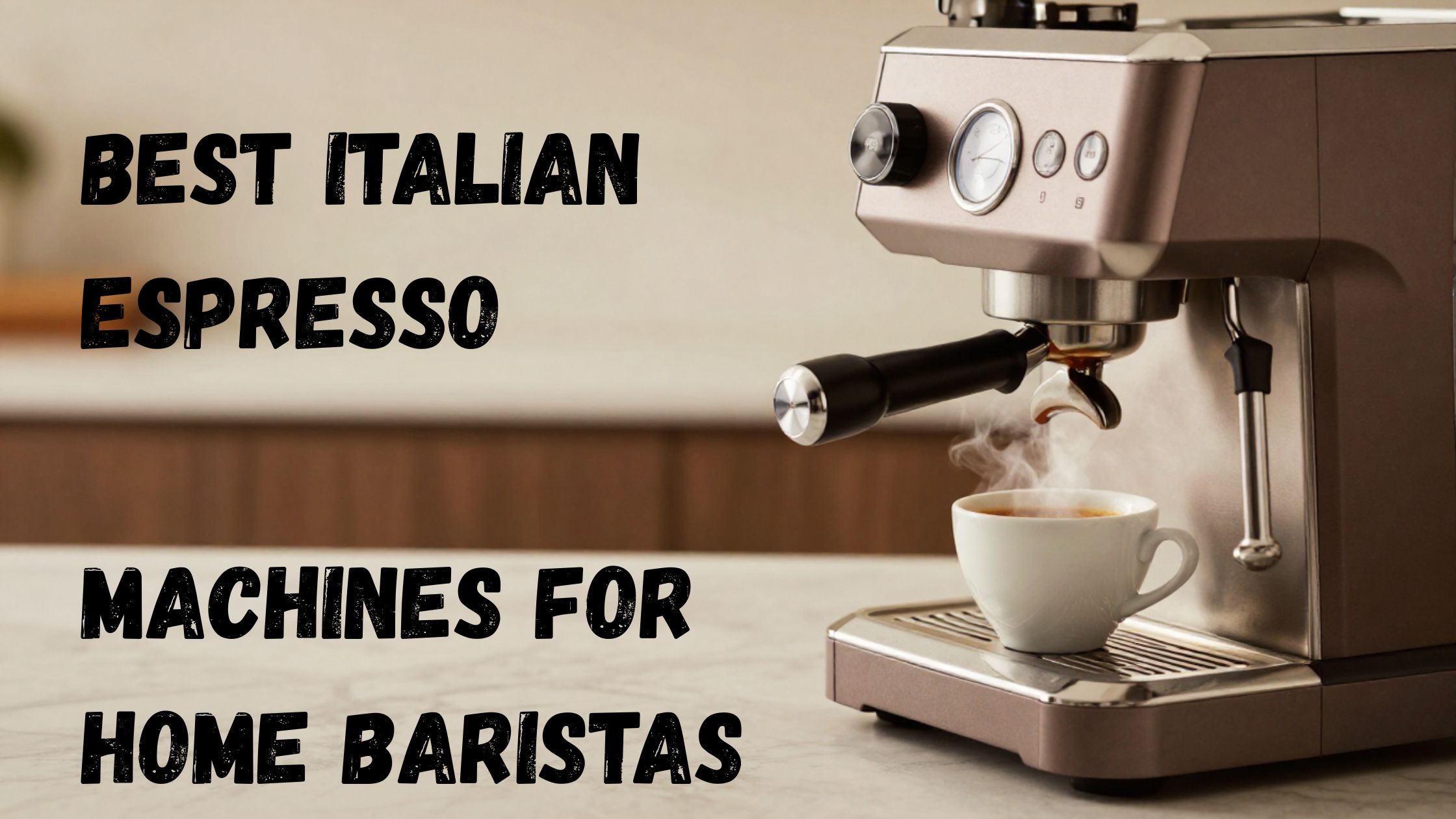

Italian espresso machines have a certain pull. Part of it is the polished steel, sturdy switches, and café-style hardware, but the real appeal is the hands-on ritual. You grind the beans, prepare the puck, watch the flow, texture the milk, and gradually learn why one shot tastes sweeter than the last. For a home barista, that feedback is far more useful than a machine covered in buttons you never touch.
Still, “Italian espresso machine” can describe several very different products. Some are designed and built in Italy; others come from Italian brands but may be assembled elsewhere. You’ll find simple single-boiler machines, integrated grinder-and-tamper models, heat-exchange machines that brew and steam together, and traditional levers that put pressure control in your hands. The best choice depends on how much practice you enjoy, how often you make milk drinks, whether you already own an espresso-capable grinder, and how much counter space you can spare.
For this guide, I selected five well-known Italian machines available through Amazon.com and compared their published specifications, brewing systems, learning curves, maintenance needs, and value for U.S. households. I didn’t rank them by pump-bar marketing or how expensive they look. A good home setup needs stable heat, appropriate pressure at the coffee puck, fresh grounds, and a workflow you will actually enjoy every morning. Prices and seller availability change frequently, so verify the exact model, voltage, warranty, and seller before ordering.
Affiliate disclosure: Improve Kitchen participates in the Amazon Services LLC Associates Program. We may earn a commission from qualifying purchases made through links in this article, at no additional cost to you.
Quick Comparison
| Espresso machine | Best for | Heating system | Grinder included | Brew and steam together? |
|---|---|---|---|---|
| Gaggia Classic E24 | Best overall value for learning | Single brass boiler | No | No |
| De’Longhi La Specialista Opera | Best all-in-one option | Thermoblock | Yes | Not a dual-boiler workflow |
| Rancilio Silvia M V6 | Best traditional single-boiler machine | 0.3-liter boiler | No | No |
| Rocket Appartamento TCA | Best premium heat-exchange machine | 1.8-liter HX boiler | No | Yes |
| La Pavoni Europiccola EPC-8 | Best manual lever experience | 0.8-liter boiler | No | Manual lever workflow |
Which Type of Italian Espresso Machine Is Right for a Home Barista?
Start with the drinks you make most often. A single-boiler semi-automatic machine, such as the Gaggia Classic E24 or Rancilio Silvia, uses one boiler for both brewing and steaming. It can make excellent espresso, but you must wait for the boiler to change temperature before frothing milk, then cool it before brewing again. This workflow suits someone who usually makes one or two drinks and does not mind learning temperature management.
An integrated machine such as the De’Longhi La Specialista Opera combines a grinder, dosing system, assisted tamping, brewing controls, and a steam wand in one body. It takes up less total room than several separate appliances and removes some early frustration. The compromise is that its built-in grinder and brewing platform offer less freedom than a carefully chosen standalone grinder paired with a traditional 58 mm machine.
A heat-exchange machine, represented here by the Rocket Appartamento TCA, keeps a large steam boiler hot while sending fresh water through a heat exchanger for brewing. It can pull a shot and steam milk at the same time, which helps with back-to-back cappuccinos. It also costs more, takes longer to warm thoroughly, and needs a capable grinder.
A manual lever machine such as the La Pavoni Europiccola has no pump controlling the shot. You lift and lower the lever to move water through the coffee, which lets you shape pressure by feel. The process is quiet and rewarding, but it has the steepest learning curve.
Whichever style you choose, budget for an espresso grinder, a scale, suitable water, cleaning supplies, and accessories. Fresh, evenly ground coffee will improve results more than an inflated pump-pressure number. Also check the origin carefully: an Italian brand name doesn’t guarantee every model is made in Italy.
1. Gaggia Classic E24 — Best Overall Italian Espresso Machine
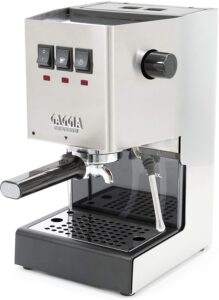
The Gaggia Classic E24 is the best starting point for someone who wants a real home-barista machine without moving immediately into four-figure prosumer territory. It is fully designed and made in Italy, uses a commercial-size 58 mm stainless-steel portafilter, and has a lead-free brass brew group and upgraded brass boiler. The E24 boiler holds more heat than the earlier version, improving brew-temperature and steam stability. Gaggia also includes traditional single- and double-shot baskets plus a pressurized option, so a beginner can start with pre-ground coffee and move to a proper espresso grinder when ready.
This machine is refreshingly mechanical. Three rocker switches control power, brewing, and steam; a three-way solenoid releases pressure after extraction and helps produce a drier puck. The professional steam wand can produce genuine microfoam once you learn its angle and timing. What you don’t get is equally important: no factory PID, pressure gauge, shot timer, or built-in grinder. You must learn to dose, grind, tamp, and manage temperature. For many coffee enthusiasts, that is the point. Gaggia’s official Classic E24 specifications confirm the 2.1-liter tank, brass boiler, 58 mm filter holder, and Italian production. It is the strongest value here for a patient beginner who wants room to develop rather than a machine that does everything automatically.
Product Features and Specifications
➡️ Model: Gaggia Classic E24, with the exact RI9380 color suffix varying by finish.
➡️ Origin: Designed and manufactured in Italy.
➡️ Heating system: Upgraded lead-free brass single boiler.
➡️ Brew group: Lead-free brass group with stainless-steel surround.
➡️ Portafilter: Commercial-style 58 mm stainless-steel filter holder.
➡️ Water tank: 2.1 liters, removable from the front.
➡️ Pump: 15-bar nominal rating; the U.S. retail configuration is designed for espresso extraction pressure.
➡️ Controls: Three rocker switches with indicator lights.
➡️ Valve: Three-way solenoid for pressure release and easier puck removal.
➡️ Steam system: Professional stainless-steel steam wand.
➡️ Dimensions: Approximately 7.9 inches wide, 14 inches high, and 10.6 inches deep.
➡️ U.S. power: 120 volts, 60 Hz, and 1,350 watts.
Pros
✅ Made in Italy with a steel body and serviceable internal design.
✅ Brass boiler improves heat retention over the previous configuration.
✅ Standard 58 mm platform supports a wide choice of barista accessories.
✅ Includes both traditional and pressurized baskets for different skill levels.
✅ Professional steam wand can produce latte-art microfoam with practice.
Cons
❌ No factory PID for setting an exact brew temperature.
❌ Single boiler cannot brew espresso and steam milk simultaneously.
❌ Requires a capable espresso grinder for the best results.
❌ Included plastic tamper is a weak match for the rest of the machine.
❌ Manual switches and temperature surfing create a learning curve for beginners.
2. De’Longhi La Specialista Opera — Best All-in-One Italian Espresso Machine
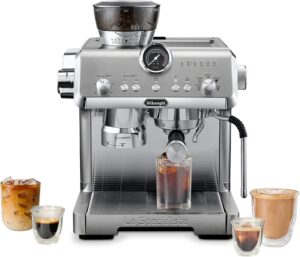
The De’Longhi La Specialista Opera makes sense for someone who loves the idea of a barista routine but doesn’t want a separate grinder, loose grounds all over the counter, or several weeks of frustrating shots. Its built-in burr grinder has 15 settings, while the Smart Tamping station applies an even tamp through a side lever. You still lock in a portafilter and steam your own milk, so the experience feels more involved than a push-button automatic machine without demanding quite as much puck-preparation skill as the Gaggia or Rancilio.
The Opera is also the most versatile option in this guide. Five presets cover espresso, Americano, hot water, cold brew, and Espresso Cool. De’Longhi says its Cold Extraction Technology can prepare cold brew in under five minutes, which is useful for American households that switch to iced coffee for much of the year. Three infusion-temperature settings let you adjust for light, medium, and dark roasts, and the pressure system uses low-pressure preinfusion before extraction at about nine bars. The official EC9555M product page lists a 67.63-ounce tank, 1,600-watt thermoblock, and commercial-style steam wand. One important distinction: De’Longhi is an Italian brand and the grinder is described as Italian-made, but buyers should check the country of origin for the exact U.S. machine rather than assuming the whole appliance is manufactured in Italy.
Product Features and Specifications
➡️ Model: De’Longhi La Specialista Opera EC9555M.
➡️ Machine style: Assisted semi-automatic espresso maker with integrated grinder.
➡️ Grinder: Built-in burr grinder with 15 grind settings.
➡️ Tamping: Smart Tamping lever applies a consistent, mess-reducing tamp.
➡️ Recipes: Espresso, Americano, hot water, cold brew, and Espresso Cool.
➡️ Temperature control: Three selectable infusion-temperature settings.
➡️ Pump: 19-bar pump with low-pressure preinfusion and approximately nine-bar extraction.
➡️ Heating: Thermoblock system.
➡️ Water tank: 67.63 ounces.
➡️ Steam system: Manual commercial-style wand for milk texturing.
➡️ Dimensions: Approximately 14 inches wide, 15 inches deep, and 17.5 inches high.
➡️ U.S. power: 120 volts and 1,600 watts.
Pros
✅ Grinder, dosing, tamping, brewing, and steaming fit into one appliance.
✅ Smart Tamping reduces mess and early puck-preparation mistakes.
✅ Hot and cold presets suit a wide range of coffee preferences.
✅ Three temperature settings allow useful adjustment for different roasts.
✅ Powerful manual steam wand gives the user control over milk texture.
Cons
❌ Large body takes considerable counter and overhead space.
❌ Built-in grinder offers less upgrade flexibility than a separate grinder.
❌ More electronics and integrated systems can make future repairs more complex.
❌ Costs more than pairing some entry-level machines with a basic grinder.
❌ Italian branding does not necessarily mean the complete machine is made in Italy.
3. Rancilio Silvia M V6 — Best Traditional Single-Boiler Machine
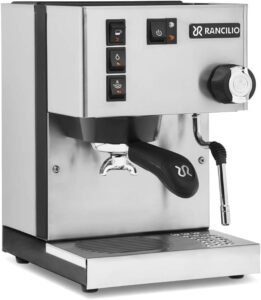
The Rancilio Silvia has remained popular because its design does not chase trends. It is a heavy, compact single-boiler machine with a brass brew group, commercial-style portafilter, stainless-steel steam wand, and straightforward switches. It has no touchscreen or guided menu to distract you. When paired with a precise grinder, it can produce rich, balanced espresso and strong steam for cappuccinos. Its sturdy frame and replaceable components also appeal to owners who would rather maintain one machine for years than replace a sealed appliance when something wears out.
Compared with the Gaggia Classic E24, the Silvia feels more substantial and has a particularly strong reputation for steam power, but its stock temperature control remains basic. The 0.3-liter boiler uses a thermostat rather than an adjustable PID, so shot-to-shot consistency depends on warm-up time and a repeatable routine. Switching from brewing to steaming also takes time because the same boiler handles both jobs. Rancilio’s official Silvia specifications list a two-liter tank, 9.3-inch width, 30.8-pound weight, brass group, and manual temperature regulation. I would recommend it to a buyer who appreciates simple, repairable equipment and expects to learn the machine’s rhythm. Anyone seeking instant convenience or precise digital temperature adjustment will be happier with a different model—or the more expensive Silvia Pro X.
Product Features and Specifications
➡️ Model: Rancilio Silvia M V6.
➡️ Machine style: Semi-automatic, single-boiler espresso machine.
➡️ Coffee boiler: 0.3 liter.
➡️ Temperature control: Manual thermostat regulation; no stock PID.
➡️ Brew group: Brass group with commercial-style ergonomic portafilter.
➡️ Basket capacity: Official portafilter specification supports baskets up to 21 grams.
➡️ Water tank: Built-in two-liter reservoir.
➡️ Pump: Internal vibration pump.
➡️ Steam system: Articulating stainless-steel steam wand with manual knob.
➡️ Dimensions: 9.3 inches wide, 11.4 inches deep, and 13.4 inches high.
➡️ Weight: Approximately 30.8 pounds.
➡️ U.S. power: 120 volts, 60 Hz, and approximately 950–1,000 watts.
Pros
✅ Heavy construction feels stable during locking and tamping.
✅ Simple internal layout supports maintenance and long-term ownership.
✅ Strong steam performance is well suited to cappuccinos and lattes.
✅ Compact 9.3-inch width fits more counters than many prosumer machines.
✅ Commercial-style group and portafilter create a serious learning platform.
Cons
❌ No factory PID, pressure gauge, or shot timer.
❌ Single boiler requires waiting between extraction and milk steaming.
❌ Temperature management takes practice and a consistent routine.
❌ A suitable espresso grinder and scale must be purchased separately.
❌ Stock features can feel sparse compared with newer machines at similar prices.
4. Rocket Appartamento TCA — Best Premium Italian Espresso Machine
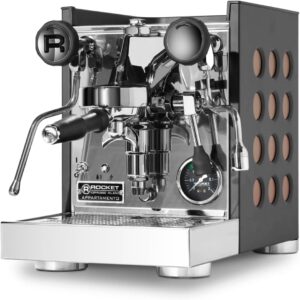
The Rocket Appartamento TCA is the step up for a home barista who makes milk drinks often and is tired of waiting for a single boiler to change temperature. Its 1.8-liter heat-exchange boiler can brew espresso and generate steam at the same time, while the heated E61-style group adds the thermal mass associated with traditional prosumer machines. The TCA version improves on the original Appartamento with four boiler-pressure settings, letting you shift the machine’s temperature behavior without installing an aftermarket controller.
This is still a hands-on machine. It doesn’t grind beans, stop a shot automatically, or display the brew temperature on a digital screen. The Temperature Control Adjustment system manages boiler pressure across presets rather than providing direct, degree-by-degree brew-water control. It also needs a full warm-up so the group, portafilter, and internal water path reach a stable temperature. Once ready, however, it has the steam capacity and workflow for several lattes or cappuccinos in succession. lists a 10.6-inch width, 1.8-liter HX boiler, vibration pump, and 48.5-pound weight. This is the most practical premium choice in the article for someone who already owns a high-quality grinder, enjoys manual extraction, and wants an Italian-built machine that looks at home in a dedicated coffee corner.
Product Features and Specifications
➡️ Model: Rocket Espresso Appartamento TCA.
➡️ Machine style: Prosumer semi-automatic heat-exchange machine.
➡️ Boiler: 1.8-liter heat-exchange boiler.
➡️ Temperature adjustment: Four pressure-based TCA settings.
➡️ Brew group: Redesigned, heated E61-style group.
➡️ Pump: Internal vibration pump.
➡️ Water supply: Removable internal reservoir; the current official page lists 1.9 liters, while some U.S. retail configurations list 2.5 liters.
➡️ Simultaneous operation: Can extract espresso and steam milk at the same time.
➡️ Dimensions: Approximately 10.6 inches wide, 17.6 inches deep, and 14.1 inches high.
➡️ Weight: Approximately 48.5 pounds.
➡️ U.S. power: 115 volts, 60 Hz, and 1,200 watts, according to Rocket’s current specification.
➡️ Grinder: Not included; a prosumer-level espresso grinder is strongly recommended.
Pros
✅ Heat-exchange boiler supports simultaneous brewing and steaming.
✅ Four TCA presets improve control compared with the original Appartamento.
✅ Narrow body is relatively compact for a full prosumer machine.
✅ E61-style group works with a broad ecosystem of 58 mm accessories.
✅ Powerful steam performance suits households that make several milk drinks.
Cons
❌ Significantly more expensive than the single-boiler options.
❌ E61 group needs a longer warm-up than a compact thermoblock machine.
❌ TCA presets are not the same as direct brew-temperature PID control.
❌ Heavy 48.5-pound body is difficult to move for cleaning.
❌ Requires a separate high-quality grinder and regular backflushing maintenance.
5. La Pavoni Europiccola EPC-8 — Best Manual Lever Espresso Machine
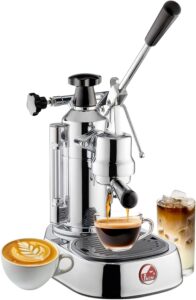
The La Pavoni Europiccola is for people who want espresso making to feel like a craft. Instead of pushing a brew button and letting a pump apply pressure, you raise the lever to fill the group and pull it down to force water through the coffee. Small changes in grind, dose, preinfusion, and lever speed are immediately noticeable. That can produce wonderfully expressive shots, but the machine does not hide mistakes. A rushed pull, stale beans, or poor distribution will show up in the cup.
Its narrow chrome base suits a smaller coffee station, and the boiler can provide steam for cappuccino after brewing. La Pavoni rates the 0.8-liter Europiccola for up to eight espresso servings, although real-world output depends on shot size and steam use. Consecutive shots require care because the group becomes progressively hotter. The boiler, group, and exposed metal surfaces also get very hot, so this isn’t the best choice for a rushed household or a counter easily reached by children. The official Europiccola specifications identify a brass boiler and group, 52 mm filter holder, manual-pressure brewing, and 0.8-liter capacity; the linked U.S. Amazon EPC-8 listing specifies 110-volt operation. Never remove the boiler cap while the machine is hot or pressurized. For a careful enthusiast who enjoys experimentation, few home machines feel as personal or as unmistakably Italian.
Product Features and Specifications
➡️ Model: La Pavoni Europiccola EPC-8, U.S. configuration.
➡️ Machine style: Manual direct-lever espresso machine.
➡️ Pressure source: User-operated lever; no electric brew pump.
➡️ Boiler: 0.8-liter brass boiler with water-level indicator.
➡️ Brew group: Chrome-plated brass group.
➡️ Filter-holder size: Approximately 52 mm.
➡️ Published capacity: Up to eight espresso cups per boiler fill.
➡️ Steam system: Manual steam wand for cappuccino and other milk drinks.
➡️ Amazon-listed footprint: Approximately 7 inches wide, 11 inches deep, and 12 inches high with the lever lowered; allow extra vertical room to raise the lever.
➡️ Weight: Approximately 14 pounds.
➡️ U.S. power: Amazon lists 110 volts and 1,000 watts for the EPC-8 configuration.
➡️ Safety: Boiler cap must never be opened while the machine is heated or under pressure.
Pros
✅ Lever gives the user direct control over preinfusion and brew pressure.
✅ Pump-free extraction is exceptionally quiet.
✅ Narrow base fits comfortably in many small coffee stations.
✅ Iconic chrome design feels distinctly Italian and timeless.
✅ Simple mechanical brewing encourages a deeper understanding of espresso.
Cons
❌ Steeper learning curve than any pump machine in this guide.
❌ Group temperature rises during repeated shots and requires careful management.
❌ Exposed boiler and metal parts become extremely hot.
❌ Small boiler must cool and depressurize before it can be safely refilled.
❌ No PID, shot timer, pressure gauge, or automatic volumetric control on the standard EPC-8.
Frequently Asked Questions
🙋 1. Are Italian espresso machines really better?
📝 Some Italian models have excellent materials, proven commercial-style designs, and strong parts support, but nationality alone does not guarantee good espresso. Temperature stability, grinder quality, water, maintenance, and the user’s technique matter more than the badge. Compare the exact model and workflow rather than buying only for country of origin.
🙋 2. Do I need a separate grinder for a semi-automatic espresso machine?
📝 Yes, unless the machine includes one, as the De’Longhi La Specialista Opera does. Espresso requires very fine, consistent grind adjustments. A general-purpose blade grinder or basic coffee grinder usually cannot provide enough control. For the Gaggia, Rancilio, Rocket, and La Pavoni, treat an espresso-capable burr grinder as part of the purchase price.
🙋 3. Is a 15-bar or 19-bar pump better for espresso?
📝 The larger advertising number is not automatically better. Traditional espresso is normally extracted at roughly nine bars at the coffee puck. A pump may produce more pressure, but valves and the brewing system regulate what reaches the coffee. Temperature, grind, dose, distribution, and flow are more useful buying considerations than maximum pump pressure.
🙋 4. Can I make regular American coffee with these machines?
📝 They do not brew drip coffee in the usual sense. You can prepare an Americano by combining espresso with hot water; the De’Longhi Opera includes a preset for it. If you regularly want a full 12-ounce mug with the flavor and texture of drip coffee, a separate coffee maker may suit you better.
🙋 5. How often should I clean and descale an espresso machine?
📝 Wipe and purge the steam wand after every use, rinse the portafilter and basket daily, and follow the manufacturer’s backflushing instructions when the machine has a three-way valve. Descaling frequency depends on water hardness and the model. Use water that protects the boiler without being completely mineral-free, and follow the manual because acids or incorrect chemicals can damage seals and metal components.
Conclusion -Best Italian Espresso Machines
The Gaggia Classic E24 is the best overall choice for most aspiring home baristas. Made in Italy, it uses a 58 mm platform and provides the essentials to learn proper espresso without an extreme starting price. Choose the De’Longhi La Specialista Opera if you want a built-in grinder and tamping system and expect to make both hot and iced drinks.
The Rancilio Silvia M V6 is the traditional workhorse for buyers who value weight, simplicity, and long-term serviceability. The Rocket Appartamento TCA is the premium upgrade for frequent cappuccinos and back-to-back drinks because its heat-exchange boiler can brew and steam together. The La Pavoni Europiccola is the most demanding choice, but it rewards those who want pressure control and ritual over automation.
Whichever machine you choose, leave room in the budget for the grinder. Match the machine to the way you drink coffee, check the U.S. voltage and seller warranty, and use water that will not coat the boiler with scale. Those decisions will affect your espresso more than another shiny accessory on the counter.