

A good espresso machine can’t compensate for unevenly ground coffee. If some particles are powdery while others remain coarse, water finds the easiest path through the puck. The result may taste sour, bitter, weak, or strangely hollow, even with fresh beans and the same recipe.
That’s why the grinder deserves as much attention as the espresso machine. A suitable model must grind finely enough to create resistance under pressure, but it also needs small, repeatable adjustments. Moving the burrs by a tiny amount can change a fast, watery shot into a balanced extraction.
Fortunately, you don’t need commercial-café money to improve your setup. The KINGrinder K6 offers genuine espresso adjustment at an entry-level price, though you must grind every dose by hand. At around the $200 tier, the Baratza Encore ESP is our best overall recommendation for beginners because half its adjustment range is dedicated to espresso. The MiiCoffee DF64 II steps into serious single-dose territory with 64mm flat burrs and stepless control. At the premium end, the Baratza Sette 270Wi adds weight-based dosing, while the Eureka Mignon Specialità combines quiet operation, timed programming, and a compact Italian-made body.
For this guide, we compared adjustment precision, burr design, retention, dosing workflow, noise, capacity, countertop size, and maintenance. Prices change frequently on Amazon, so the budget categories are approximate. More importantly, each recommendation suits a different type of coffee routine. A hand grinder works for a single morning drink, while a fast electric model is much more practical for making several lattes or cappuccinos.
Quick comparison of our top picks
| Grinder | Best for | Burrs | Adjustment | Dosing style |
|---|---|---|---|---|
| KINGrinder K6 | Budget buyers | 48mm stainless-steel conical | External stepped adjustment | Manual single dose |
| Baratza Encore ESP | Best overall for beginners | 40mm M2 conical steel | 40 stepped settings | Hopper or dosing cup |
| MiiCoffee DF64 II | Midrange enthusiasts | 64mm stainless-steel flat | Stepless | Electric single dose |
| Baratza Sette 270Wi | Weight-based convenience | 40mm conical | 30 macro plus micro adjustment | Grind by weight |
| Eureka Mignon Specialità | Premium quiet workflow | 55mm hardened-steel flat | Stepless micrometric | Timed hopper dosing |
Why does espresso require a specialized grinder?
Espresso has a much narrower working range than most other brewing methods. Hot water is pushed through a compact bed of finely ground coffee under pressure. The coffee particles create resistance, so grind size directly affects how quickly the water passes through the puck.
If the grounds are too coarse, water moves through too quickly, and the shot may taste thin, sharp, or sour. If they are too fine, the machine may struggle to push water through, producing a slow extraction that can taste harsh or bitter. A small adjustment that would barely affect French press coffee can add several seconds to an espresso shot.
This is why the number and size of adjustments matter. A basic grinder may technically reach an espresso-fine setting but have large gaps between its numbered positions. One setting might run too fast, while the next nearly stops the machine. A stepless model removes fixed positions and lets you move the burrs in very small increments. A well-designed stepped model can also work, provided its espresso range has sufficiently close adjustments.
Consistency is just as important. Burr grinders crush beans between two controlled surfaces, producing a narrower particle distribution than blade grinders. Burr alignment, motor stability, and manufacturing tolerances all influence the result.
Retention should also be considered. Retention is the coffee left inside the grinding chamber or chute after a dose. Excessive retained grounds can become stale and mix with the next batch. Single-dose machines use short pathways, bellows, or anti-static systems to reduce this problem.
A specialist grinder won’t automatically produce a balanced shot. You still need fresh beans, an accurate scale, even puck preparation, and a sensible recipe. It simply gives you the control required to make useful adjustments instead of guessing.
1. KINGrinder K6 Manual Coffee Grinder — Best under $100
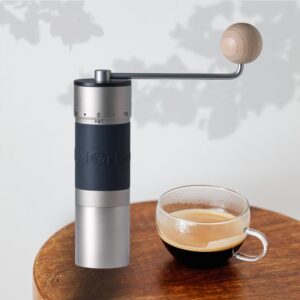
The KINGrinder K6 is a sensible entry point for someone who wants capable espresso adjustment without paying for an electric motor. Its external adjustment collar offers 60 clicks per full rotation, with each click moving the burr by about 16 microns. Because the collar supports multiple rotations, it can move from fine espresso settings to much coarser pour-over or French press territory.
Inside the aluminum body is a 48mm, seven-core stainless-steel conical burr. That relatively large burr grinds more efficiently than many inexpensive hand mills with smaller cutting surfaces. It holds about 30 grams, enough for a double espresso with room to spare or a modest manual-brewing dose.
External adjustment is especially useful. You don’t need to remove the catch cup and reach underneath the burr every time a new bag requires a finer setting. Numbered markings also make it easier to return to a previous recipe.
The tradeoff is physical effort. Grinding an espresso-fine dose takes longer and requires more force than preparing coarse filter coffee, particularly with dense light-roast beans. It is comfortable for one or two drinks, but making several back-to-back cappuccinos can get tiring.
For budget-conscious buyers, travelers, and households that don’t make many drinks at once, the K6 puts more money into burr quality and adjustment than into electronics. The Amazon listing confirms its current configuration and accessories.
Product Features and Specifications
➡️ Manual grinder requires no electrical outlet.
➡️ Uses a 48mm, seven-core stainless-steel conical burr.
➡️ External collar allows grind changes without removing the catch cup.
➡️ Provides 60 adjustment clicks per complete rotation.
➡️ Each click changes the burr position by approximately 16 microns.
➡️ Multiple rotations cover espresso and manual brewing methods.
➡️ Holds approximately 30 grams of whole coffee beans.
➡️ Aluminum body provides a sturdy exterior.
➡️ Straight handle supplies leverage for fine grinding.
➡️ Compact design is suitable for travel and small kitchens.
Pros
✅ Costs considerably less than most capable electric models.
✅ Fine external adjustments make espresso dialing easier.
✅ Large conical burr grinds faster than many small hand mills.
✅ Requires little countertop space.
✅ Low-retention single-dose workflow wastes very little coffee.
Cons
❌ Every dose must be ground manually.
❌ Fine light-roast coffee can require substantial effort.
❌ It becomes inconvenient when making several drinks.
❌ Thirty-gram capacity limits large filter-coffee batches.
❌ There is no timer, scale, or portafilter holder.
2. Baratza Encore ESP — Best overall for beginners
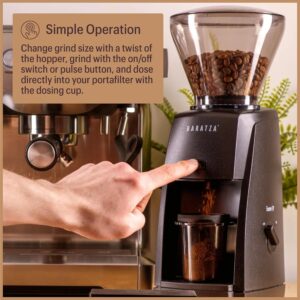
The Baratza Encore ESP is our best overall recommendation for someone buying a first electric espresso grinder. It keeps the Encore’s familiar, straightforward controls but changes the internal adjustment system to offer better resolution at the fine end. Settings 1 through 20 cover espresso, while 21 through 40 move progressively through drip, pour-over, French press, and cold brew.
You can remove the 40mm M2 conical steel burr without disassembling the entire machine, making routine brushing and deeper cleaning less intimidating. You select grind size by rotating the hopper. A side pulse button provides quick manual control, while the front switch supports continuous operation.
Baratza supplies both a conventional grounds bin and an espresso dosing cup. The cup includes a 58mm adapter, allowing grounds to be transferred more cleanly into a standard commercial-size portafilter. Owners of 51mm or 54mm equipment can still use the cup, though it won’t lock directly onto those baskets.
This model makes sense for households that alternate between espresso and brewed coffee. It isn’t as precise as a fully stepless grinder, and its plastic-heavy construction feels less substantial than the DF64 or Eureka. Still, it covers the needs of most entry-level machines without a complicated interface. Baratza also sells replacement parts and publishes repair guidance, which can matter after several years of regular use. Baratza’s official product page provides current support information.
Product Features and Specifications
➡️ Contains 40 total grind settings.
➡️ Settings 1 through 20 provide smaller espresso-focused adjustments.
➡️ Settings 21 through 40 cover common brewed-coffee methods.
➡️ Uses a 40mm M2 conical steel burr.
➡️ Quick-release upper burr simplifies cleaning.
➡️ Grind adjustment is controlled by rotating the bean hopper.
➡️ Includes a conventional grounds bin.
➡️ Comes with an espresso dosing cup and 58mm adapter.
➡️ Front switch supports continuous grinding.
➡️ Side-mounted pulse button provides manual control.
Pros
✅ Espresso-focused settings are easier for beginners to understand.
✅ Can switch between espresso and filter coffee.
✅ Included dosing cup creates a cleaner workflow.
✅ Quick-release burr makes maintenance less intimidating.
✅ Replacement parts and manufacturer support are widely available.
Cons
❌ Stepped adjustment can occasionally place the ideal setting between two numbers.
❌ It doesn’t include programmable timed dosing.
❌ Plastic housing feels less premium than metal-bodied models.
❌ Some coffee can remain in the chute between doses.
❌ Operation is louder than premium sound-insulated machines.
3. MiiCoffee DF64 II — Best midrange single-dose grinder
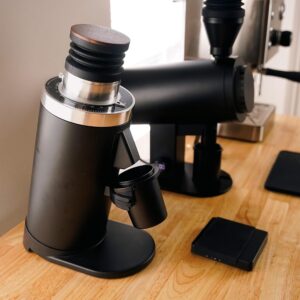
The MiiCoffee DF64 II is designed for people who weigh each dose before grinding and frequently change coffee beans. Instead of filling a large hopper for the week, you measure the exact amount needed, place it in the small upper chamber, grind it, and use the bellows to move remaining grounds through the chute.
Its 64mm stainless-steel flat burrs are a significant step up in size from typical entry-level conical burrs. The grinder also accepts several aftermarket 64mm burr sets, letting experienced users change particle distribution and cup character without replacing the whole machine.
Adjustment is fully stepless. The large collar moves in tiny increments, which helps when a shot needs a small correction but the next marked number is too far away. Labels around the dial provide general reference points for espresso and brewed coffee, although users should record their own settings for each bean.
A plasma generator in the exit chute reduces static, while the short grinding pathway and bellows target retention below 0.1 gram under favorable conditions. Actual retention will vary with bean type, roast level, cleanliness, and how you use the grinder.
The DF64 II has no timer, screen, or programmable button. A separate scale is essential because the machine expects you to measure every dose. Its 15-pound body also isn’t something most people will want to move daily. For home baristas who prefer fresh single dosing and fine control over push-button convenience, it offers considerable capability at a midrange price. Full technical details are available from MiiCoffee.
Product Features and Specifications
➡️ Uses custom 64mm stainless-steel flat burrs.
➡️ Burrs can be replaced with compatible 64mm aftermarket options.
➡️ Stepless adjustment permits very small grind-size changes.
➡️ Plasma generator is positioned in the exit chute to reduce static.
➡️ Bellows help clear retained grounds from the chamber.
➡️ Manufacturer-stated retention is below 0.1 grams under suitable conditions.
➡️ Hopper holds approximately 30 grams without the bellows or up to 80 grams with it.
➡️ Includes a 58mm food-grade aluminum dosing cup.
➡️ Uses a 250-watt motor at a fixed speed of approximately 1,400 rpm.
➡️ Measures approximately 9 inches deep, 5 inches wide, and 14 inches high.
➡️ Weighs approximately 15 pounds.
Pros
✅ Large flat burrs provide a strong foundation for serious espresso.
✅ Stepless collar allows precise shot adjustments.
✅ Low-retention design suits frequent bean changes.
✅ Anti-static system helps reduce countertop mess.
✅ Standard 64mm format supports future burr upgrades.
Cons
❌ A separate coffee scale is required.
❌ Bellows add another step to every grinding cycle.
❌ There are no programmable doses or an automatic shutoff timer.
❌ Fifteen-pound body is inconvenient to move.
❌ Burr upgrades can add substantially to the total cost.
4. Baratza Sette 270Wi — Best for grind-by-weight convenience
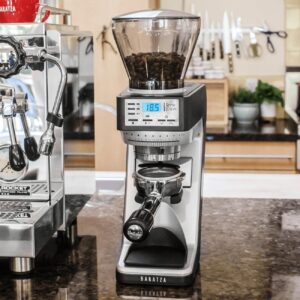
The Baratza Sette 270Wi is built for home espresso drinkers who want the grinder to measure the dose automatically. Instead of programming only a grinding time, you select a target weight and place the portafilter or included grounds bin on the convertible holder. The internal weighing system, developed with Acaia technology, monitors the output and stops near the programmed amount.
Three dose buttons can store commonly used weights. This is convenient for households that switch between single baskets, double baskets, and other brewing devices. Baratza says dosing can be controlled to one-tenth of a gram, though results can vary with vibration, how the portafilter sits in the holder, and coffee behavior.
The adjustment system combines 30 numbered macro positions with a stepless micro ring divided into nine marked sections. This provides about 270 reference points while still allowing smaller adjustments between them. The straight-through grinding path also supports speeds of up to approximately five grams per second and limits the amount of coffee left behind.
The Sette has a tall, distinctive body and is known more for speed than quiet operation. Its sound is difficult to ignore in a sleeping household, even though a typical espresso dose finishes quickly. The scale and electronic controls also make it more complicated than a simple single-dose machine.
For someone preparing several drinks each morning, however, automatic weight-based dosing can remove repeated measuring from the routine. Baratza’s published specifications include the current electrical and dimensional information.
Product Features and Specifications
➡️ Built-in scale uses Acaia weighing technology.
➡️ Programs doses in 0.1-gram increments.
➡️ Includes three programmable weight presets.
➡️ Provides 30 macro grind positions.
➡️ Stepless micro ring has nine marked reference sections.
➡️ Approximately 270 adjustment references support espresso dialing.
➡️ Straight-through pathway reduces areas where grounds can collect.
➡️ Grinding speed reaches approximately five grams per second.
➡️ Convertible holder supports a portafilter or supplied grounds bin.
➡️ Uses hardened-steel conical burrs.
➡️ Approximate dimensions are 5.1 inches wide, 9.8 inches deep, and 16.1 inches high.
➡️ US model operates on 100–120 volts with a 200-watt rating.
Pros
✅ Automatically measures coffee by weight.
✅ Three presets speed up repeated drink preparation.
✅ Macro and micro controls provide extensive adjustment.
✅ Fast grinding is useful for several back-to-back drinks.
✅ Straight-through design keeps retention relatively low.
Cons
❌ It is louder than most premium home grinders.
❌ Tall body may not fit below low kitchen cabinets.
❌ Weight-based electronics add cost and complexity.
❌ Portafilter placement can affect weighing performance.
❌ Its appearance and plastic construction won’t suit every coffee station.
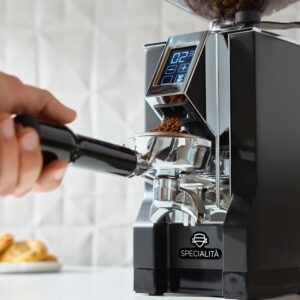
The Eureka Mignon Specialità is a compact hopper grinder for people who regularly use the same espresso beans and want fast, repeatable timed doses. Its sound-insulated metal body and anti-vibration design make it noticeably more suitable for early mornings than a high-speed Sette. The machine is handmade in Florence, Italy, and has a narrow footprint despite weighing approximately 14.6 pounds.
Inside, 55mm hardened-steel flat burrs spin at about 1,350 rpm. The stepless micrometric adjustment system uses a small dial to move the burrs without fixed click positions. This allows fine corrections when an espresso runs a few seconds too quickly or too slowly.
A backlit touchscreen stores separate single- and double-dose times, with continuous grinding available for manual control. The adjustable fork supports hands-free grinding directly into a portafilter. Eureka’s ACE system is designed to limit clumping and static as coffee exits the chute.
The Specialità is most convenient when its hopper stays filled with a single bean. You can adapt it for single dosing with third-party accessories, but that isn’t its original purpose. Switching frequently between espresso and coarse filter settings is also inconvenient because the stepless dial may require several rotations and offers limited reference markings.
For a dedicated espresso station, its quiet operation, compact build, and precise timed dosing create an appealing daily workflow. Eureka lists its full performance details on the official Mignon Specialità page.
Product Features and Specifications
➡️ Uses 55mm hardened-steel flat burrs.
➡️ Stepless micrometric system permits fine adjustments.
➡️ Motor runs at approximately 1,350 rpm.
➡️ Power consumption is rated at 310 watts.
➡️ Manufacturer lists espresso productivity at approximately 1.8 to 2.5 grams per second.
➡️ Touchscreen stores one single-dose and one double-dose time.
➡️ Continuous mode provides manual grinding control.
➡️ ACE system is designed to reduce clumping and static.
➡️ Sound-insulated body and anti-vibration components reduce operating noise.
➡️ Adjustable fork supports hands-free portafilter dosing.
➡️ Hopper capacity is approximately 300 grams, or about 12 ounces.
➡️ Approximate dimensions are 4.7 inches wide, 7.1 inches deep, and 13.8 inches high.
Pros
✅ Sound insulation suits early-morning use.
✅ Stepless adjustment provides precise espresso control.
✅ Timed single and double presets simplify daily dosing.
✅ Narrow body occupies little counter width.
✅ Fifty-five-millimeter flat burrs grind quickly and consistently.
Cons
❌ It costs considerably more than entry-level electric models.
❌ Timed dosing is less exact than true weight-based dosing.
❌ Small adjustment dial takes practice to control.
❌ Switching repeatedly between espresso and filter settings is inconvenient.
❌ Hopper-based design retains more coffee than a dedicated single-dose workflow.
How to choose an espresso grinder
Set a realistic budget
➡️ A capable manual model can cost less than $100.
➡️ Entry-level electric options usually begin around the $200 range.
➡️ Stepless single-dose grinders often fall into the $300–$500 tier.
➡️ Premium models charge more for quieter operation, larger burrs, dosing technology, or heavier construction.
Choose between manual and electric
➡️ Manual grinders put more of the purchase price into burrs and adjustment.
➡️ They work well for one or two daily shots.
➡️ Electric models are much faster when preparing several drinks.
➡️ A motorized machine is usually the better match for a busy family coffee station.
Understand stepped and stepless adjustment
➡️ Stepped models click into fixed numbered positions.
➡️ Fine espresso-focused steps can still provide excellent control.
➡️ Stepless models allow almost unlimited positions between dial markings.
➡️ A stepless collar is useful for precise dialing but may be harder to return to a previous setting.
Consider your dosing routine
➡️ Hopper grinders are convenient when using the same beans every day.
➡️ Single-dose machines suit people who weigh beans and change coffees frequently.
➡️ Timed dosing is fast but can change slightly as beans age.
➡️ Weight-based dosing reduces the need to weigh every dose separately.
Check countertop clearance
➡️ Measure the grinder with its hopper and lid installed.
➡️ Leave enough room to remove the hopper for cleaning or refilling.
➡️ Tall machines may fit under a cabinet but still lack the clearance required to open them.
➡️ Heavy grinders are best left in a permanent position.
Frequently asked questions
🙋 Are flat burrs better than conical burrs for espresso?
📝 Neither shape is automatically better. Flat burrs are often associated with a more uniform particle distribution and clearer flavor separation. Conical burrs may produce more fine particles, which can contribute to a heavier, more traditional espresso texture. Burr geometry, alignment, manufacturing quality, motor stability, and adjustment precision matter more than shape alone.
🙋 Is a stepless grinder necessary for espresso?
📝 No. A stepped model can work well when its espresso settings are close together, as on the Baratza Encore ESP. Stepless control becomes more useful with unpressurized baskets, light-roast coffee, or machines where tiny grind changes noticeably alter shot time.
🙋 Can a regular coffee grinder make espresso?
📝 Some general-purpose burr grinders can grind finely, but that doesn’t mean they provide enough adjustment at that end of the range. A grinder may move from a shot that is too fast to one that nearly chokes the machine. Blade grinders are unsuitable because they create an uneven mixture of powder and coarse fragments.
🙋 What grind setting should I use for espresso?
📝 There is no universal setting because burr calibration, coffee density, roast level, dose, basket, and machine all affect the result. Begin within the manufacturer’s suggested espresso range. A common starting recipe is about twice as much liquid espresso as dry coffee, pulled in roughly 25–35 seconds, but taste should guide final adjustments. Grind finer if the shot is fast and sour; move coarser if it is excessively slow and bitter.
🙋 How often should an espresso grinder be cleaned?
📝 Brush the chute and accessible surfaces regularly, especially when using oily dark-roast coffee. A deeper burr-chamber cleaning every four to eight weeks is a reasonable starting point for home use, but high-volume households may need it sooner. Always follow the manufacturer’s disassembly instructions, unplug electric equipment first, and avoid washing metal burrs with water unless the manual specifically allows it.
Conclusion – Best Espresso Grinders
The Baratza Encore ESP offers the most balanced starting point for a first home espresso setup. It is simple, repairable, versatile enough for brewed coffee, and has 20 closely spaced settings dedicated to espresso.
Choose the KINGrinder K6 if the lowest possible cost matters more than speed. The MiiCoffee DF64 II is the stronger upgrade for enthusiasts who weigh every dose and want stepless control with 64mm flat burrs. The Baratza Sette 270Wi makes sense when automatic, weight-based dosing matters more than quiet operation. For a dedicated premium coffee station, the Eureka Mignon Specialità combines precise adjustment, timed programming, and much calmer early-morning sound.


