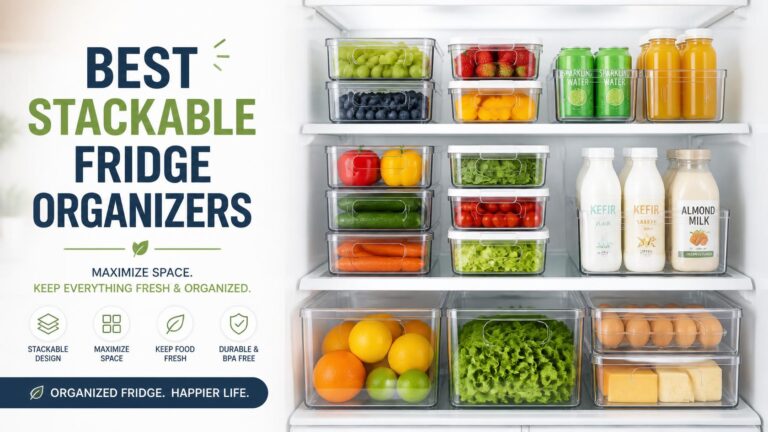
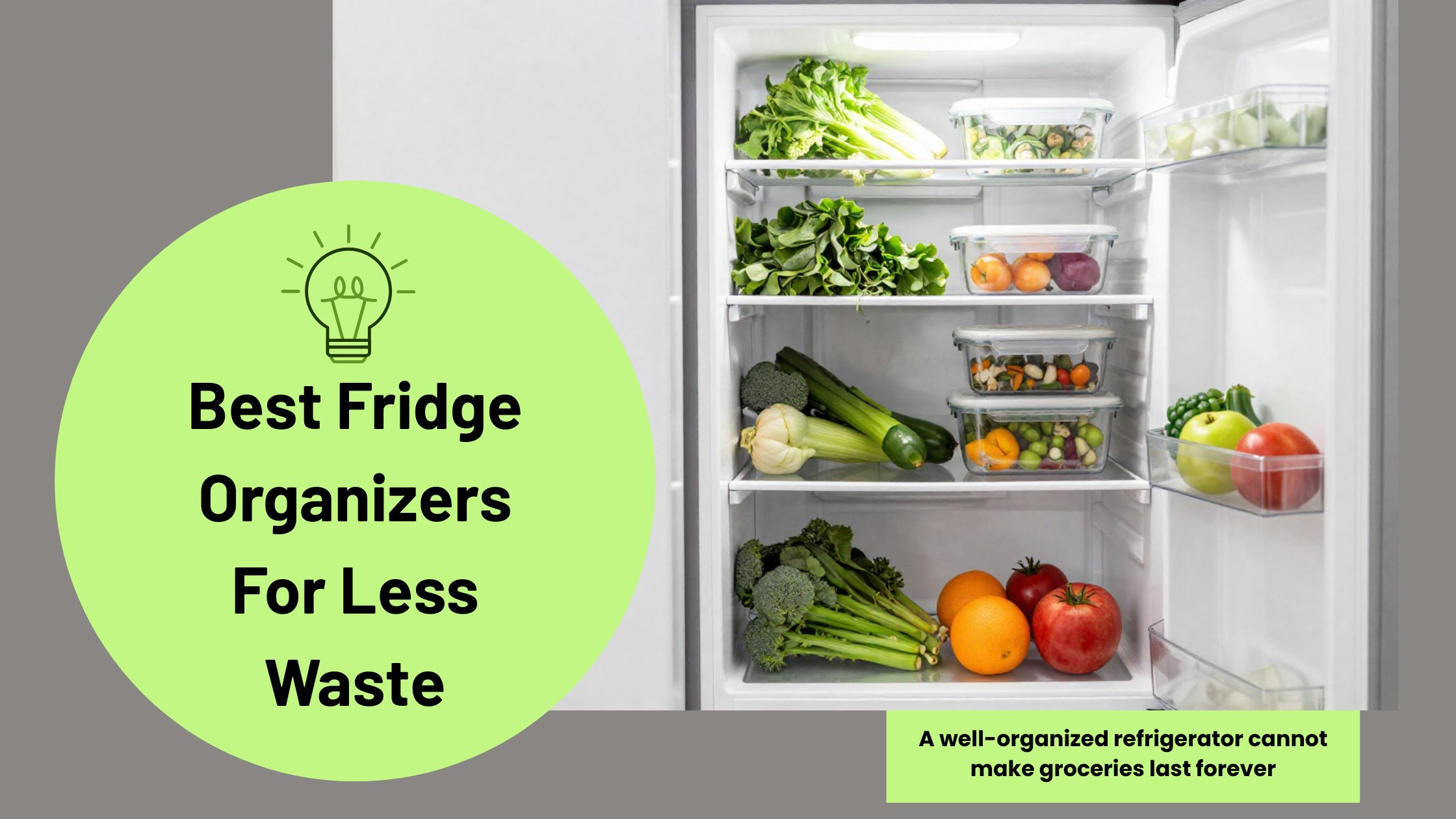

A well-organized refrigerator cannot make groceries last forever, but it can solve one expensive problem: food disappearing behind other food. When leftovers, berries, yogurt cups, and opened condiments stay visible, it is easier to plan meals around what needs attention first. The best organizers support that habit without blocking cold-air circulation, creating hard-to-clean corners, or forcing every grocery into a decorative container. Clear bins, a turntable, and one intentional “eat first” zone can be more useful than a refrigerator packed with matching plastic.
For this guide, I chose ten products that address different sources of household waste. Open bins group ingredients by use, produce keepers manage airflow and moisture, an under-shelf drawer reclaims empty space, and a rolling egg dispenser encourages first-in-first-out rotation. A shelf riser prevents short containers from hiding beneath tall ones, while a beverage dispenser separates cans from perishable foods. Measure every option against your actual shelf depth, door swing, vents, lights, and drawer clearance before purchase.
Food safety remains more important than visual order. The FDA recommends keeping a refrigerator at 40°F or below, cleaning spills promptly, and separating raw meat, poultry, seafood, and eggs from ready-to-eat foods. Clean and sanitize any organizer that held leaking raw food before reusing it. Dates and appearance also have limits: harmful bacteria may be present even when food looks normal. Use labels, follow storage guidance, and discard food when safety is uncertain. My overall pick is the OXO four-bin starter set for flexible visibility; produce-heavy households should begin with Rubbermaid FreshWorks or Progressive ProKeeper containers instead.
How should I organize a refrigerator to use food before it spoils?
Begin with zones, not products. Reserve an eye-level bin or tray for “Eat First” foods: opened packages, ripe produce, and leftovers approaching their planned use date. Label prepared food with the name and date, then place newer items behind older ones. That first-in-first-out pattern matters more than the color of the containers. Keep ingredients for a repeated meal—smoothies, lunches, or tacos—in a handled bin so you can pull the whole group out at once.
Protect food safety while organizing. Maintain 40°F or below with an appliance thermometer and leave enough open space for cold air to circulate. Store raw meat, poultry, and seafood securely so juices cannot drip onto ready-to-eat foods; a washable containment tray on the lowest suitable shelf is useful. Don’t move milk, eggs, or other temperature-sensitive items to a warmer door compartment just because an organizer fits there.
Measure shelf width, depth, height, and door clearance before ordering. Include the space required to pull a drawer or rotate a turntable. Choose clear, removable pieces you can wash easily, and avoid so many bins that cleaning becomes a project. Once a week, scan the Eat First area, wipe spills, and plan one meal from what is already open. The organizer provides visibility; the short weekly routine turns that visibility into less waste.
Quick Comparison
| Product | Best for | Format | Main waste-reduction benefit |
|---|---|---|---|
| OXO 4-Piece Starter Set | Best overall | Four clear bins | Flexible visible zones |
| iDesign Linus Bins | Narrow shelves | Two handled bins | Pull-out category storage |
| YouCopia FridgeView | Condiments and jars | 11-inch turntable | Brings rear items forward |
| OXO Shelf Riser | Short containers | Adjustable platform | Uses vertical shelf space |
| OXO 14-Inch Under-Shelf Drawer | Deli and cheese | Hanging drawer | Creates a dedicated use-first zone |
| YouCopia RollDown | Egg rotation | Two-tier dispenser | Oldest egg rolls forward |
| Rubbermaid FreshWorks | Produce | Vented containers | Airflow and moisture separation |
| Progressive ProKeeper Set | Produce variety | Five vented keepers | Adjustable produce storage |
| OXO 3-Piece Tray Set | Leftovers and packages | Nesting trays | Visual expiration check |
| Simple Houseware Can Dispensers | Canned drinks | Two sloped organizers | Frees shelf space for perishables |
1. OXO Good Grips 4-Piece Fridge Storage Bin Starter Set — Best Overall
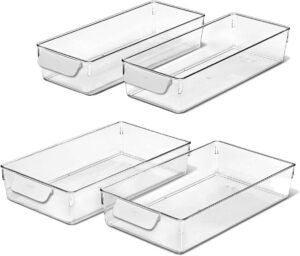
OXO’s four-piece starter set is the easiest way to add structure without redesigning the entire refrigerator. The clear modular bins come in two sizes, with rounded front handles and smooth bases that slide across a shelf. Visibility is the key advantage: a household can designate one bin for “Eat First,” one for lunch ingredients, one for snacks, and one for opened condiments while still seeing what remains. Pulling out a complete category is also more efficient than moving five jars individually to reach the back.
Bins don’t extend shelf life on their own, and they can hide food if packed above the clear sightline. Keep categories narrow, use simple removable labels, and avoid filling every inch. The rigid sides also occupy some space, so measure internal width and shelf depth rather than relying on refrigerator capacity in cubic feet. Smooth bases glide well, but a heavily loaded bin still needs two-handed support. Cleaning is straightforward when you remove the category before a leak spreads; confirm current dishwasher instructions because care guidance can differ by component.
This set is ideal for a mixed household that needs flexible grouping more than specialty egg or produce storage. It makes the best first purchase because the bins can change jobs as shopping habits change, and an obvious Eat First container can create immediate behavior change without a complex system.
Product Features and Specifications
➡️ Set size: four clear refrigerator bins in two sizes.
➡️ Design: modular shapes intended to fit together visually.
➡️ Access: rounded front handles.
➡️ Base: smooth underside for shelf gliding.
➡️ Best uses: leftovers, snacks, meal components, and opened packages.
➡️ Setup requirement: measure shelf depth, width, and door clearance first.
Pros
✅ Clear walls keep contents visible.
✅ Multiple sizes support flexible categories.
✅ Handles make back-shelf food easier to retrieve.
✅ One bin can become a dedicated Eat First zone.
✅ Neutral design works in most refrigerator layouts.
Cons
❌ Bin walls consume some usable shelf width.
❌ Overfilling can hide small items.
❌ Heavy loads are awkward to pull one-handed.
❌ No lids or produce-vent controls are included.
❌ A full set may not fit compact or side-by-side refrigerators.
2. iDesign Linus Collection Organizer Bins — Best for Narrow Shelves
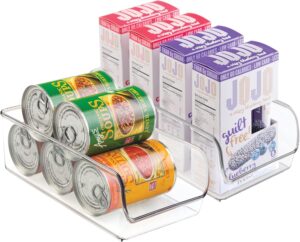
The iDesign Linus bins offer a narrower footprint than many broad refrigerator tubs. The cited pair measures approximately 11 by 7 by 3.5 inches per bin and uses clear BPA-free plastic with integrated handles. That scale is helpful in a counter-depth refrigerator or a side-by-side model where wide organizers can leave an unusable strip. One bin can hold yogurt and cheese; the other can corral small sauces, snack packs, or smoothie ingredients. Because the sides are low, labels and package dates remain relatively easy to see.
Open bins work best for sealed items, not unwrapped food. They do not control humidity, and a leak can spread across everything in the category. Use a separate, washable lowest-shelf tray for raw animal products, and never let a general snack bin become cross-contaminated. iDesign describes the plastic as food-safe and suitable for refrigerator/freezer use, but the model is hand-wash only. That care requirement is easy to overlook and may matter in a busy household.
The molded handles are convenient, but pulling a fully loaded bin by one end can flex the contents and cause it to tip. Support the bottom whenever the load is heavy. These bins are a practical value for shoppers who already understand which categories need containment. They are less effective when bought as a matching set without a specific assignment; label each one based on the food you regularly lose track of.
Product Features and Specifications
➡️ Quantity: two clear organizer bins in the cited package.
➡️ Approximate size: 11 by 7 by 3.5 inches each.
➡️ Material: BPA-free transparent plastic, according to the listing.
➡️ Access: integrated front handles.
➡️ Temperature use: listed for refrigerator and freezer organization.
➡️ Care: hand wash with mild soap; do not assume dishwasher safe.
Pros
✅ Narrow dimensions suit constrained refrigerator shelves.
✅ Low clear sides preserve label visibility.
✅ Handles help bring rear items forward.
✅ Pair allows two distinct food categories.
✅ Simple shape is easy to repurpose in a pantry.
Cons
❌ Hand washing adds maintenance.
❌ No lid or humidity control.
❌ Open top cannot contain a major spill.
❌ Handle-only lifting feels unstable when overloaded.
❌ Exact fit depends on careful shelf measurement.
3. YouCopia FridgeView 11-Inch Turntable — Best for Condiments and Jars
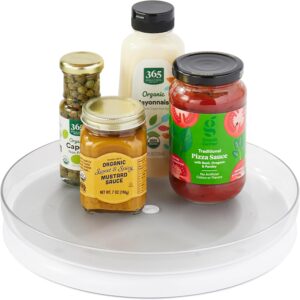
A turntable solves the deep-shelf problem differently: instead of pulling out a bin, you rotate the back into view. YouCopia’s FridgeView is an 11-inch carousel that turns 360 degrees on stainless-steel ball bearings. Raised edges help contain jars, and non-slip feet keep the base from migrating during a spin. It is particularly useful for opened sauces, jams, dressings, and small jars that otherwise form a forgotten second row.
Round storage inevitably leaves some empty space at the corners of a rectangular shelf. Measure the full diameter plus room for nearby items; a door bin or shelf lip can block rotation even when the platform technically fits. Tall narrow bottles can tip if spun aggressively, and a very heavy load may make access less smooth. Arrange the largest containers toward the center, keep labels facing outward, and rotate gently.
The turntable is not appropriate for uncovered leftovers or raw meat packages that could leak. It also cannot tell you which sauce is oldest, so add date labels and place the soonest-to-use item at a consistent position. FridgeView earns a recommendation because a single rotation creates a quick inventory without removing six bottles. It is most valuable in a deep top shelf or awkward corner; in a shallow refrigerator, a straight-handled bin may use space more efficiently.
Product Features and Specifications
➡️ Diameter: 11 inches on the cited model.
➡️ Motion: full 360-degree rotation.
➡️ Mechanism: stainless-steel ball bearings.
➡️ Stability: non-slip feet.
➡️ Best contents: sealed condiment bottles, jars, and small containers.
➡️ Fit note: allow clearance for complete rotation and the refrigerator door.
Pros
✅ Makes rear condiments visible in seconds.
✅ Smooth rotation reduces repeated lifting.
✅ Raised perimeter helps keep jars on the platform.
✅ Non-slip feet protect and grip the shelf.
✅ Easy to repurpose in a pantry or cabinet.
Cons
❌ Round footprint wastes rectangular corner space.
❌ Tall bottles can tip during a fast spin.
❌ Eleven-inch diameter may crowd narrow shelves.
❌ Does not automatically enforce first-in-first-out order.
❌ Unsuitable for leaking raw-food packages.
4. OXO Good Grips Adjustable Fridge Shelf Riser — Best for Vertical Space
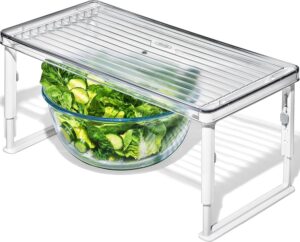
The OXO shelf riser creates a second level for short containers that would otherwise sit in front of one another. Five adjustable height positions let you tailor the platform to yogurt cups, jars, or shallow leftovers, while tapered legs leave accessible room underneath. Non-slip feet work on both solid and wire refrigerator shelves, and installation requires no tools. This can be especially useful on a tall shelf where moving the appliance shelf would make the shelf above impractical.
A riser improves visibility only when the arrangement stays deliberate. If the top becomes a pile of miscellaneous food, the lower level can be harder to see and clean. Assign the platform one job—breakfast cups above and meal-prep containers below, for example, and keep the front open enough to check dates. Measure not only the riser’s footprint but also the available height with food sitting on both levels. Do not place excessive weight on the platform or block a rear air vent, light, filter, or temperature sensor.
A spill can travel underneath the feet, so lift the entire unit during weekly cleaning. The shelf riser is a smart choice for renters because it changes capacity without adhesive or drilling. It is less helpful in a tightly spaced side-by-side model where vertical clearance is already limited.
Product Features and Specifications
➡️ Adjustment: five height settings.
➡️ Installation: tool-free assembly and repositioning.
➡️ Feet: non-slip design for solid or wire shelves.
➡️ Leg shape: tapered to preserve storage underneath.
➡️ Best use: short jars, yogurt, meal-prep boxes, and leftovers.
➡️ Safety: follow listed weight limits and keep vents and sensors clear.
Pros
✅ Converts unused height into visible storage.
✅ Adjustable platform fits several container sizes.
✅ No adhesive or permanent alteration is required.
✅ Non-slip feet work on common shelf types.
✅ Can separate Eat First food from newer items.
Cons
❌ Requires enough vertical clearance to be useful.
❌ Food beneath the platform can still be overlooked.
❌ Spills collect around and under the legs.
❌ Platform has a finite safe load.
❌ Poor placement may interfere with cold-air circulation.
5. OXO Good Grips 14-Inch Under-Shelf Drawer — Best for Deli Meat and Cheese
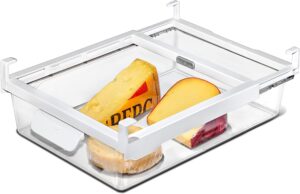
OXO’s 14-inch under-shelf drawer turns the unused band beneath a flat refrigerator shelf into accessible storage. Its adjustable frame attaches without tools, and the clear drawer slides out by a rounded handle. Deli meat, sliced cheese, tortillas, and small produce packs are natural candidates because their flat shapes are easily buried in a main bin. Assigning the drawer to open packages also creates an automatic Eat First zone.
Compatibility is the main challenge. The mounting frame is intended for flat shelves, and thick lips, unusual glass trim, wire geometry, lights, or narrow door clearance can prevent a secure fit. Measure the shelf as a three-dimensional object, not just its width. After installation, open the refrigerator door to its normal angle and confirm the drawer extends without hitting a bin or door compartment. Do not exceed the stated weight limit or store leaky raw meat above ready-to-eat food.
The clear construction shows inventory, but stacked opaque packages still need dated labels. Removing the drawer for cleaning is also important because crumbs and moisture can collect at the frame. This organizer is a particularly clever option for apartment refrigerators with limited drawer space. If your appliance already has a full-width deli compartment, it may duplicate storage rather than solve a problem.
Product Features and Specifications
➡️ Width class: 14-inch model.
➡️ Mounting: adjustable under-shelf frame.
➡️ Installation: tool free on compatible flat shelves.
➡️ Construction: clear drawer with rounded pull handle.
➡️ Best contents: deli packages, cheese, tortillas, and small produce.
➡️ Fit warning: verify shelf edge, door, light, and nearby-bin clearance.
Pros
✅ Uses space that often remains empty.
✅ Pull-out design keeps flat packages accessible.
✅ Clear walls make quantity easy to scan.
✅ Excellent location for an Eat First category.
✅ No permanent hardware is required.
Cons
❌ Does not fit every refrigerator shelf profile.
❌ Drawer can collide with door bins in tight layouts.
❌ Reduces headroom on the shelf below.
❌ Mount and drawer require periodic cleaning.
❌ Weight capacity limits dense packages.
6. YouCopia RollDown Egg Dispenser — Best for First-In-First-Out Egg Rotation
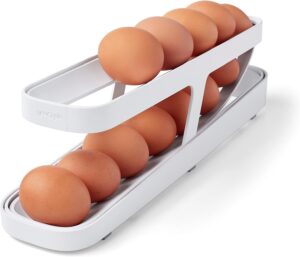
The YouCopia RollDown uses a two-tier gravity-fed track to bring the next egg forward after one is removed. It holds roughly 12 to 14 eggs across standard, large, and jumbo sizes according to the listing. The compact footprint saves the width of some cartons, and non-slip feet keep the dispenser steady. Rotation is its real benefit: if you load new eggs behind the remaining older ones, the earliest eggs naturally reach the front first.
Removing eggs from their labeled carton has trade-offs. The carton carries grade, size, pack information, and date details that are useful for food-safety decisions. If you use a dispenser, transfer or photograph the relevant date and write it on a removable label. Do not combine a new dozen with older eggs without a clear rotation plan. Place the dispenser on a cold interior shelf rather than a warmer door location, and keep raw shell eggs separated from ready-to-eat foods.
Rolling is gentle, but cracked eggs can contaminate the track; discard cracked eggs as appropriate and wash the unit promptly, following care directions. This product works best for households that buy one dozen at a time and value narrow vertical storage. Families purchasing flats or multiple cartons should consider the larger 24-plus-egg version or keep the original packaging.
Product Features and Specifications
➡️ Capacity: approximately 12 to 14 eggs.
➡️ Compatibility: standard, large, and jumbo eggs listed.
➡️ Feed: two-tier gravity rolling track.
➡️ Stability: non-slip feet.
➡️ Setup: arrives ready to load without assembly.
➡️ Labeling need: preserve carton dates and identifying information separately.
Pros
✅ Naturally presents older eggs first when loaded correctly.
✅ Two tiers save shelf width.
✅ Front access makes remaining quantity obvious.
✅ Non-slip feet reduce shifting.
✅ Handles several common U.S. egg sizes.
Cons
❌ Removing the carton discards useful printed information.
❌ A cracked egg can soil the entire track.
❌ Capacity may not hold an older remainder plus a new dozen.
❌ Needs interior-shelf space rather than the warmer door.
❌ Track requires careful washing after contamination.
7. Rubbermaid FreshWorks Produce Saver Set — Best for Everyday Produce
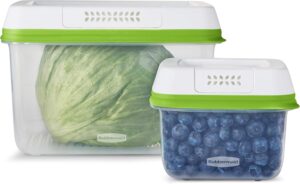
Rubbermaid FreshWorks containers address moisture and airflow, not just simple grouping. The cited four-piece package includes one medium-short and one large container with matching lids. FreshVent technology regulates gas flow through a built-in filter, while an elevated base keeps produce away from accumulated moisture. Clear walls let you see berries, greens, grapes, or cut vegetables, and the compatible bases can stack or nest when not in use.
No produce container works equally well for every fruit and vegetable. Some items need high humidity; others benefit from ventilation, and ethylene-producing fruit can accelerate nearby ripening. Follow the specific produce guidance instead of filling one large keeper with unrelated foods. Drying washed produce thoroughly also matters; excess water introduced during storage can overwhelm the moisture-separation design. The container takes up more volume than a flexible bag, and the raised insert reduces usable interior space. Still, the format makes an excellent bridge between food preservation and visibility.
It is especially useful for a household that repeatedly loses berries or greens in an opaque crisper drawer. The manufacturer says the integrated filter doesn’t need refills, eliminating a recurring supply cost. Check the current dishwasher placement directions, and clean every layer after spoilage or leakage. FreshWorks can support longer quality, but refrigerator temperature and safe handling remain essential.
Product Features and Specifications
➡️ Cited set: one 4.6-cup medium-short and one 18.1-cup large container with lids.
➡️ Airflow: built-in FreshVent filter.
➡️ Moisture control: elevated base separates produce from collected moisture.
➡️ Visibility: clear walls.
➡️ Storage: stackable in use and nestable when empty.
➡️ Filter care: manufacturer states no replacement refills are needed.
Pros
✅ Designed specifically around produce airflow and moisture.
✅ Clear containers make inventory easy to check.
✅ Two sizes handle berries, greens, and larger vegetables.
✅ Built-in filter avoids replacement purchases.
✅ Elevated base keeps food above pooled moisture.
Cons
❌ Rigid walls consume more space than bags.
❌ Insert and lid add cleaning steps.
❌ Different produce may require different storage conditions.
❌ Large container may dominate a narrow shelf.
❌ A container cannot compensate for unsafe refrigerator temperature.
8. Progressive Prepworks ProKeeper Five-Piece Produce Set — Best for Produce Variety
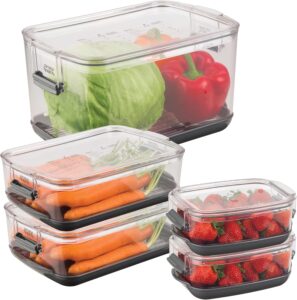
The Progressive ProKeeper collection is a more specialized system for households that buy several types of produce each week. The cited five-piece bundle includes large Produce ProKeepers and smaller Berry ProKeepers. Flow-through vent systems and adjustable reservoir bases let users control moisture and airflow, while removable lower components double as colanders for rinsing. Printed storage guides on the clear lids provide a convenient reminder when you are unsure whether vents should be open or closed.
Customization is the strength and the complication. Vents must be set correctly, produce needs appropriate preparation, and five containers create numerous parts to wash. Rinsing directly in a keeper is convenient, but berries and greens should be dried according to their storage needs rather than returned dripping wet. The substantial 5.7-quart units require deep shelf space, so map out their home before buying the full bundle. Clear walls keep food visible, yet stacking too high may hide lids and labels.
Progressive lists the components as BPA-free and dishwasher-safe, which is helpful for maintenance, but confirm rack placement and drying instructions. This set is best for a produce-forward family prepared to use its adjustability. A shopper who only needs a home for one clamshell of strawberries will find a single Berry ProKeeper or the smaller Rubbermaid set more economical and easier to maintain.
Product Features and Specifications
➡️ Set: five produce-storage containers in multiple sizes.
➡️ Large capacity: 5.7-quart Produce ProKeeper format listed.
➡️ Berry capacity: 1.2-quart Berry ProKeeper format listed.
➡️ Controls: flow-through vents and adjustable reservoir bases.
➡️ Multipurpose part: removable bottom can serve as a colander.
➡️ Material/care: BPA-free and dishwasher-safe, according to the listing.
Pros
✅ Multiple sizes separate produce with different needs.
✅ Adjustable vents provide more control than an open bin.
✅ Colander bases simplify rinsing.
✅ Printed guides help users choose a setting.
✅ Clear construction supports quick inventory checks.
Cons
❌ Five containers require significant shelf space.
❌ Many lids, vents, and inserts increase washing.
❌ Incorrect vent settings may reduce the benefit.
❌ Wet produce may still spoil quickly if stored improperly.
❌ Full set is excessive for light produce shoppers.
9. OXO Good Grips 3-Piece Fridge Storage Tray Set — Best for an Eat-First Shelf
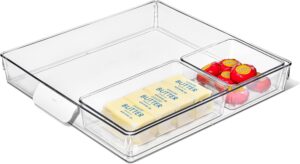
OXO’s three-piece tray set is an understated way to prevent flat packages and small leftovers from disappearing. A large tray holds deli meat, cheese, or a larger package, while small and mini trays nest to create separate compartments. The clear material keeps dates visible, and the smooth base lets the entire assembly glide forward. Unlike tall bins, low trays define a boundary without hiding the lower half of labels.
That open design is perfect for an Eat First shelf. Put the week’s oldest safe leftovers in the front tray, open cheese in one small section, and a ripe ingredient in the other. The system is less appropriate for uncontained raw meat or anything likely to leak, because the low sides offer limited spill protection. It also adds no humidity, airtight seal, or insulation. Don’t pack trays so tightly that containers cannot cool properly, and food-safety storage times still apply no matter where an item sits.
Their low profile makes cleaning easier than deep drawers, though you must lift every piece when a spill travels underneath. Choose this set when the problem is forgotten flat food rather than lack of refrigerator capacity. It creates a visual priority lane, which often influences waste more than another sealed specialty container.
Product Features and Specifications
➡️ Components: one large, one small, and one mini clear tray.
➡️ Layout: smaller trays nest within the larger unit.
➡️ Visibility: low clear sides preserve package and date sightlines.
➡️ Base: smooth design intended to glide on a shelf.
➡️ Best use: deli packages, cheese, small leftovers, and Eat First foods.
➡️ Limitation: open trays are not airtight and have limited leak containment.
Pros
✅ Low walls keep flat package labels visible.
✅ Nesting pieces create custom compartments.
✅ Excellent framework for a weekly Eat First zone.
✅ Smooth base pulls forward easily.
✅ Trays are easy to repurpose as shopping habits change.
Cons
❌ Open format does not contain a major leak.
❌ No produce vent or airtight function.
❌ Small trays reduce the large tray’s continuous area.
❌ Food can still be forgotten if the tray is overpacked.
❌ Spills underneath require lifting the whole set.
10. Simple Houseware Soda Can Organizer Dispenser, Set of Two — Best for Beverage Rotation
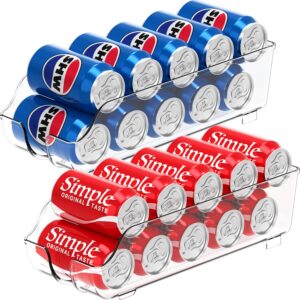
Simple Houseware’s clear dispensers organize standard 12-ounce cans in two layers. An elevated rear creates a gentle slope so the next can rolls forward, while a U-shaped front cutout makes it easier to grip the lower row. Each unit measures approximately 14 inches deep, 5.75 inches wide, and 3.5 inches high. The cited package includes two, keeping sparkling water and soda—or two flavors—separate.
Drinks aren’t usually the most perishable refrigerator item, but disorganized cans take up shelf space that could hold leftovers and produce. A narrow rolling dispenser consolidates them and makes quantity obvious before shopping. It can also encourage older cans to reach the front first when new stock is loaded from the rear. Measure carefully: 14 inches is deep for some counter-depth models, and the stacked-can height needs clearance beneath the shelf above.
Don’t assume the clear plastic model is stackable unless the listing says so; this version organizes cans in layers within each tray, not by stacking loaded dispensers on top of one another. Condensation and sticky leaks collect at the bottom, so remove cans and wash the tray periodically. This is a useful finishing piece after perishable-food zones are working, not the first organizer a food-waste-focused household needs.
Product Features and Specifications
➡️ Quantity: two clear can organizers.
➡️ Can format: intended for standard 12-ounce beverage cans.
➡️ Feed: slanted base encourages forward rolling.
➡️ Access: U-shaped front thumb opening.
➡️ Approximate dimensions: 14 by 5.75 by 3.5 inches each.
➡️ Placement: refrigerator or pantry; verify height with both can layers loaded.
Pros
✅ Consolidates cans into a predictable footprint.
✅ Forward feed keeps the next drink accessible.
✅ Clear sides show remaining inventory.
✅ Pair separates flavors or drink types.
✅ Frees loose shelf space for more perishable food.
Cons
❌ Fourteen-inch depth may not fit a counter-depth refrigerator.
❌ Designed mainly for standard cans, not every slim or tall format.
❌ Loaded height can interfere with the shelf above.
❌ Condensation and leaks collect in the tray.
❌ Beverage organization has less direct effect on food waste than an Eat First bin.
Frequently Asked Questions
🙋 Do refrigerator organizers actually reduce food waste?
📝 They can help when they improve visibility and support first-in-first-out rotation. They cannot extend every food’s safe life or replace meal planning. Use one clearly labeled Eat First zone, date leftovers, put newer items behind older ones, and review the refrigerator before shopping.
🙋 What temperature should a refrigerator be?
📝 The FDA and USDA recommend 40°F or below; use an appliance thermometer rather than relying only on the control dial. Do not block vents or pack shelves so tightly that cold air cannot circulate. Follow official guidance after power outages or suspected temperature problems.
🙋 Should I wash produce before putting it into a keeper?
📝 Follow the produce and container directions. Some berries and greens deteriorate faster when stored wet, so dry them thoroughly if you rinse them first. FDA guidance advises washing whole produce under running water—not soap or detergent—before preparation or eating.
🙋 Where should raw meat go in an organized refrigerator?
📝 Keep raw meat, poultry, and seafood securely contained and separated from ready-to-eat foods so juices cannot drip or spread. A washable tray on the lowest suitable shelf can help contain spills. Clean and sanitize promptly after any leak, following food-safety guidance.
🙋 How often should I clean refrigerator bins?
📝 Wipe spills immediately and wash a bin whenever food leaks, spoils, or leaves residue. A quick weekly review catches smaller messes and forgotten food. Follow each organizer’s care instructions; some clear plastics are hand-wash only and can warp or craze in a dishwasher.
Conclusion – Best Refrigerator Organizers:
Start with the problem that costs your household the most. If leftovers and opened packages disappear, the OXO four-piece starter set or three-piece tray set can establish a visible Eat First zone. Deep shelves benefit from the YouCopia turntable, while tall shelves become more useful with OXO’s adjustable riser. The under-shelf drawer is excellent for flat deli packages when your shelf shape is compatible.
Produce-heavy shoppers should prioritize Rubbermaid FreshWorks for a straightforward two-size system or Progressive ProKeeper for more adjustable vents and container sizes. The iDesign bins are useful in narrow refrigerators, the YouCopia dispenser supports egg rotation, and Simple Houseware’s can trays reclaim space from loose drinks.
Measure before buying and resist filling every shelf with plastic. The goal is to see food, clean spills, maintain airflow, and make the oldest safe item the easiest one to reach. Keep the refrigerator at 40°F or below, separate raw and ready-to-eat foods, date leftovers, and spend five minutes each week planning from the Eat First area. That routine—not a perfectly styled refrigerator — turns organization into less wasted food and fewer duplicate grocery purchases.